

Predictator - May 2023
Authoritarian leader popularity as a bellwether of instability.

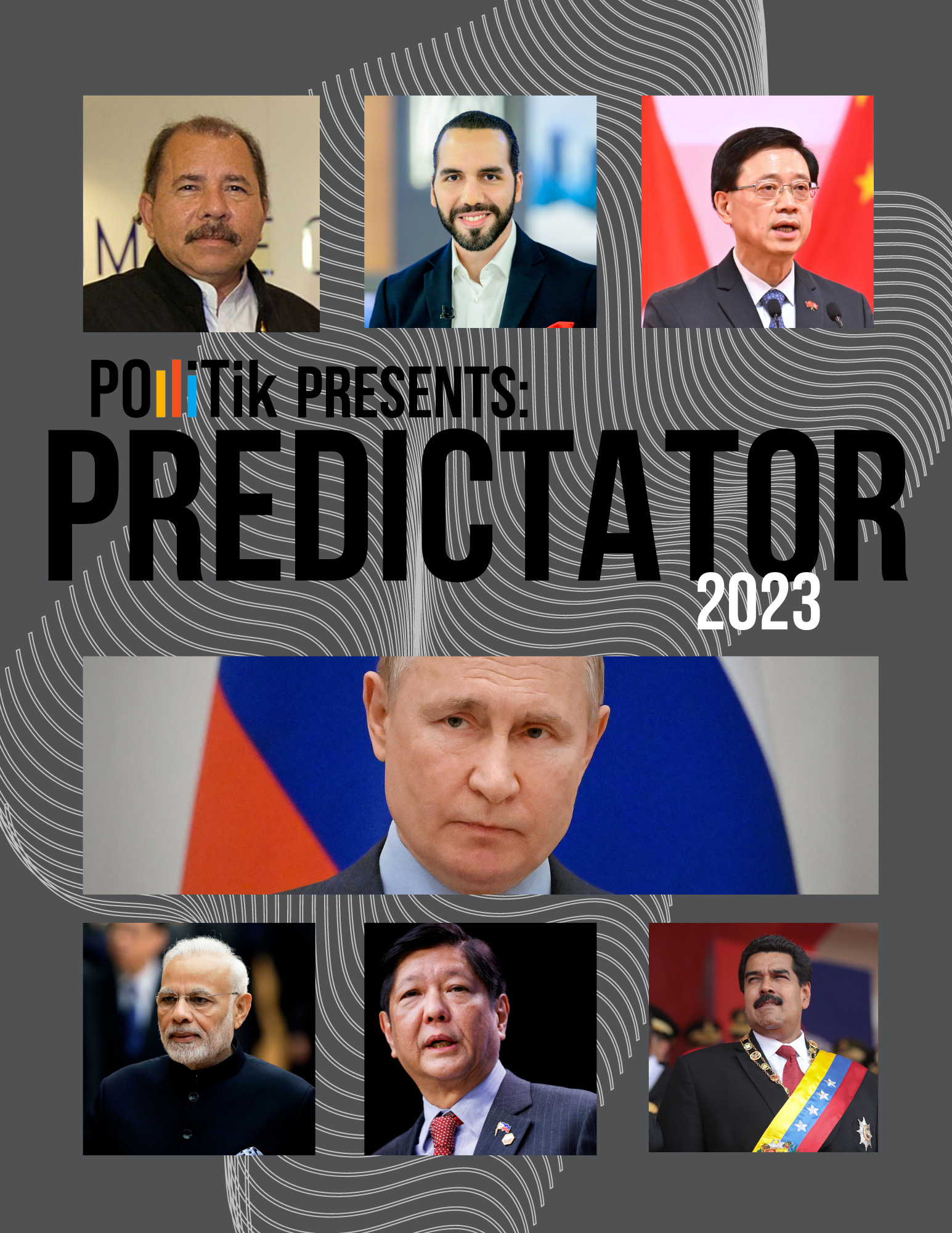
Pollitik’s Predictator continuously tracks public support for authoritarian and autocratizing leaders, per V-Dem. Popularity data are monthly estimates from the Executive Approval Project (EAP).
Through January of 2023, Russia, Hong Kong, Nicaragua, India, El Salvador, Philippines and Venezuela were all ruled by authoritarian and autocratizing leaders. Our November 2022 edition included Brazil, Hungary and Türkiye. But Lula da Silva’s defeat of Jair Bolsonaro in the 2022 presidential elections has led us to exclude Brazil. And insufficient data has forced us to exclude Hungary and Türkiye.
The graph covers the erosion rate for liberal democracy in each country per V-Dem’s liberal democracy index found in their 2022 democracy report.
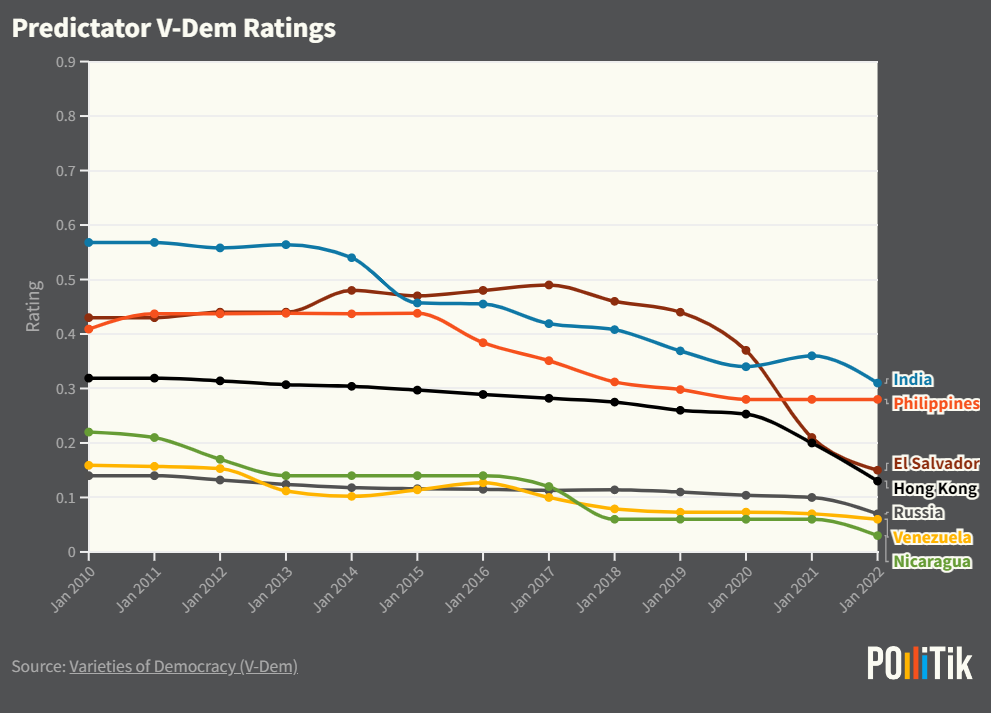
Erosion of Liberal democracy
The past year has continued the unfortunate trend of El Salvador becoming less democratic rapidly after declaring emergency and arresting over 53,000 alleged gang members. As the right of association, the right to be informed of the reason for an arrest and access to a lawyer are suspended, gang violence and the government response there has driven a spiral of increased policing and corruption.
Hong Kong is similarly placed low on V-Dem’s liberal democracy index, as it assimilates to the central authority in China.
Nicaragua faces an even worse outlook for its democracy than before with multiple newspapers being shut-down, opposition leaders being arrested ahead of elections, over 200 NGOs getting banned and 90+ political opponents losing their citizenship. With V-dem rating less than 0.1, Nicaragua ranks amongst the lowest of any country in the world.
The world’s largest democracy (by population) - India - is in decline, as evidenced by the fierce rise of Hindutva nationalism, attacks against the media including raids on the BBC office and bans on documentaries, and the controversial disqualification of the main opposition leader from the parliament.
Approval Ratings
Below is a graph of the monthly approval data we have on each leader.
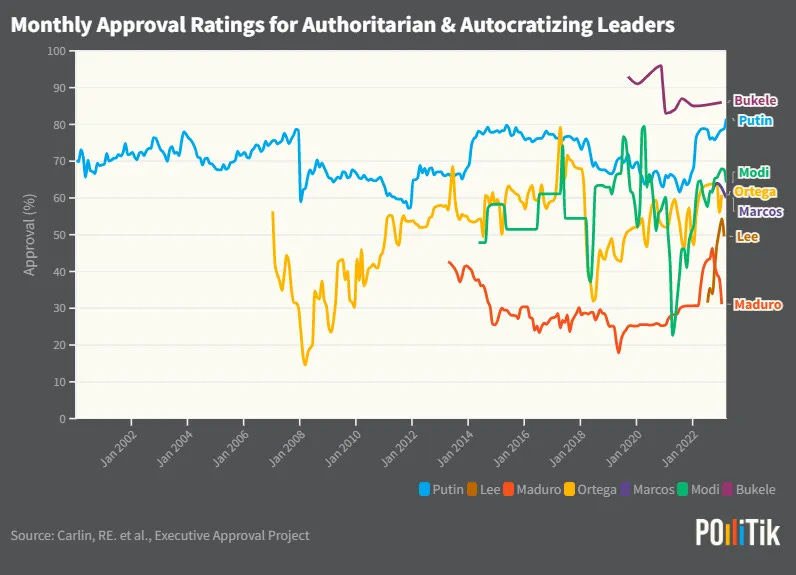
Regardless of how much one may support liberal democracy it is undeniable that authoritarian leaders are capable of earning the sincere support of their populace. A notable example of this would be Nayib Bukele who once again is the most popular leader in our lists, with a staggering high of 96% and a still impressive low of 86%. While his crackdown of gangs and related controversies have drawn the ire of human rights organizations and other pro-democracy interests, it seems the Salvadoran people are willing to make trade offs of these human rights for security in their country. Since implementing his anti-gang crackdown his popularity has only increased. Reuters has reported that nearly 70% of the population favor’s his bid for a second term.
Putin’s approval rating reached a peak that benefits from the rally around the flag effect after a year of war in Ukraine; his approval rating going from 67% in January of 2022 to 79% in September of that same year. Both examples demonstrate the very real risk that illiberal governments may manage to entrench themselves not just through naked force but by the more subtle and powerful means of widespread approval.
Maintaining control through widespread support is easier said than, as the next two will demonstrate. The lowest popularity estimates are registered by Hong Kong’s John Lee Ka-chiu (49%) and Maduro (31%). Such results are, perhaps, unsurprising. Lee has led an extremely controversial integration of Hong Kong into the mainland Chinese political system, a campaign which has likely hurt his approval amongst the integration skeptical population of Hong Kong.
Maduro’s strikingly low approval rating is similarly unsurprising given that he has overseen a marked degeneration of Venezuela's political and economic system. But we would be remiss to focus purely on the highest and lowest rated leadership, as with any such ranking system there are those who are overshadowed by the extremes.
India and the Philippines boast the highest V-Dem score in the cohort but fall in middle of the pack for approval. Modi (64%) is a bombastic and personalistic leader with a durable base of support. Marcos (60%) leads the Philippines in the shadow of his father's legacy of authoritarian dictatorship.
Tellingly while these leaders are middle ranking amongst those in the Predictator, their approval ratings are quite high in absolute terms. Many a President or Prime Minister would metaphorically sell their firstborn for such numbers.
Approval Volatility
Predictator analyzes the overall volatility of leaders’ support in addition to approval ratings as it may shape leaders’ actions. As we can see in the many real world examples throughout our article, the public’s approval of their leaders is influenced by internal forces. Here, we find the most volatile approval ratings belong to Ortega (standard deviation = 11.92) followed by Modi (9.46) and the least volatile approval ratings belong to Duterte (2.00) followed by Bukele (4.40).
Conclusion
Predictator’s ultimate goal is to shed light on the potential moments of instability in countries where democracy is in short supply. Through our data it is clear that high approval ratings can coexist with increasing authoritarianism; Bukele and Putin have overseen highly rated government while being described as dictators. Alongside this display is cases where the government is significantly authoritarian and the leaders trudge along with lower approval ratings. This finding indicates that democracy, or the lack of, can not alone explain how a leader is regard by their people. The data is accurate as of May 2023.