

POLICY MOOD RING: Abortion Preferences in the United States
A look at how the American public's abortion attitudes have trended over time.


Last February, Adriana Smith visited a hospital with severe headaches, received medication and was sent home. The next day she found herself at Emory University Hospital on life-support but declared brain-dead. Doctors determined she had irreparable blood clots in her brain.
Adriana was pregnant: her baby’s due date, however, was over three months away. Georgia’s 2019 near-total abortion ban law went into effect after the 2022 Supreme Court decision to overturn Roe v Wade. Abiding by this law, doctors at Emory refused to take Adriana off of life support, because “the state bans abortion after cardiac activity can be detected.” For three months, Adriana was kept alive until the hospital performed a cesarean section to deliver her son, Chance, who weighed just 1 pound 13 ounces. Adriana was taken off of life support four days later.
In a post-Roe world, this case highlights the real-life impacts laws governing abortion law. But where do Americans position themselves on this issue? Has it changed over time and, if so, why?
Views on abortion, 1995-2026
According to political scientist James A. Stimson, “The slow shift of public opinion is one of the central forces in American politics.” Tracking the changing preferences of the American public can help us to infer how the public reacts to policy and the direction future policy is likely to take. Americans’ mood toward abortion, for example, may not align with the topic’s hyper-polarized treatment by politicians and media but may nonetheless indicate which way the policy wind is blowing.
The graphic below suggests support for legal abortion in all or most cases trended stronger until about 2024. And despite the seemingly stark divide between political parties on the topic, a majority of Americans support it.
% of U.S. adults who say abortion should be…
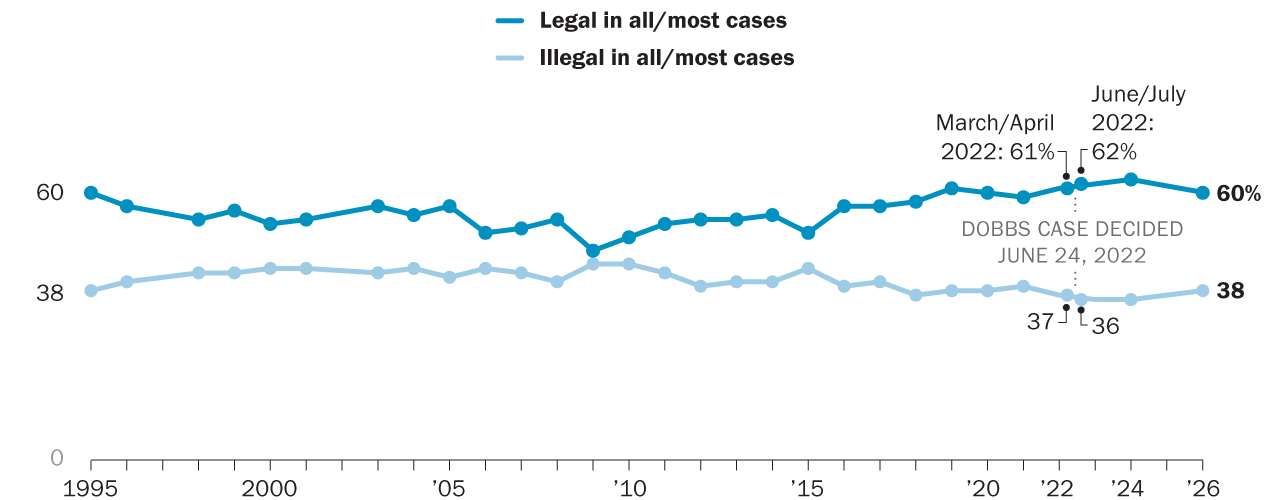
Americans became increasingly supportive of more liberal abortion policy between roughly 2008 and the Dobbs decision in 2022. The election of President Barack Obama and the Blue Wave that swept into Congress in 2009 raised the specter that Roe v. Wade, or a more liberal policy, might be codified into law. State legislatures reacted with a wave of increasingly restrictive abortion legislation, including Texas House Bill 2 (HB2), heartbeat bills, mandatory waiting periods, and clinic regulation.
Between 2011 and 2019, the hundreds of abortion restrictions enacted by states, made that decade one of the most active periods of abortion policymaking since Roe v. Wade and substantially reduced access in many parts of the country (Stimson, Tides of Consent, Ch.3; Nash et. al, 2019). By 2019, several states had enacted six-week “heartbeat” bans and/or other restrictions directly challenging the constitutional framework established under Roe, signaling that abortion policy was becoming increasingly restrictive at the state level.
Simultaneously, the Supreme Court became increasingly conservative, which raised questions regarding the future of Roe v. Wade. Specifically, appointments to the Court during this period produced a conservative majority, which many took as a signal that the constitutional protections established under Roe v. Wade could eventually be reconsidered.
Together, these developments (growing state-level restriction and a changing Supreme Court) are consistent with thermostatic public opinion, in which citizens gradually adjusted their preferences in response to an increasingly restrictive political environment rather than reacting only after the Dobbs decision itself.
Despite differences in survey methodology, both the individual survey series and the updated policy mood estimates show a gradual increase in support for more liberal abortion policy beginning around 2013 and continuing through Dobbs, followed by relatively stable levels of support afterwards.
This nuanced data is something even Stimson acknowledges in Tides of Consent: “It is difficult to make sense of trends in abortion attitudes.” Additionally, an interesting chart from Stimson shows the correlations between partisanship and abortion attitudes, which suggests the issue has become more party-aligned over time:
Abortion became an issue in which tradition - be it religious or constitutional - had no answers to. Because it was new, it created a dangerous issue: attitudes did not fall along party lines. Prior to Roe V. Wade, support for abortion came from Americans with higher incomes, were well educated, and voted for Republicans. In fact, 69% of delegates to the 1972 Republican National Convention expressed support for abortion rights, while many Democrats of the time tended to be more aligned with the views of the Catholic Church.
Consequently, abortion attitudes did not fall along party lines, making it a controversy that political candidates on both sides began to latch onto, mobilizing their primary voters by taking the “correct” side and thus winning their race. Eventually, those who are out-of-line with their party’s new issue alignment will be replaced with a candidate who fully is.
Roe & Dobbs: What do the data say?
When we frame the issue evolution of abortion in America with this historical context, we can begin to make sense of why court cases that we would assume had major and lasting shifts in public opinion on the topic - Roe v. Wade (1973) and most recently, Dobbs v. Jackson Women’s Health Organization (2022) - and why they actually did not. Because Dobbs overturned nearly fifty years of federal abortion protections and returned abortion policy to the states, many expected public opinion to shift dramatically in response.
To see what the data say, we return to Stimson’s abortion preferences dataset in order to estimate a summary measure of the public’s position on the liberal-conservative spectrum — their “mood” towards abortion policy — and to see its interplay with shifting abortion policies and laws.
After incorporating newly available data from Pew and AP-NORC surveys, our updated abortion mood estimates in the graph below do in fact show an increasingly liberal views on abortion, but not one as large as many may have expected (from 61% support in April 2022, to 62% support in June 2022).
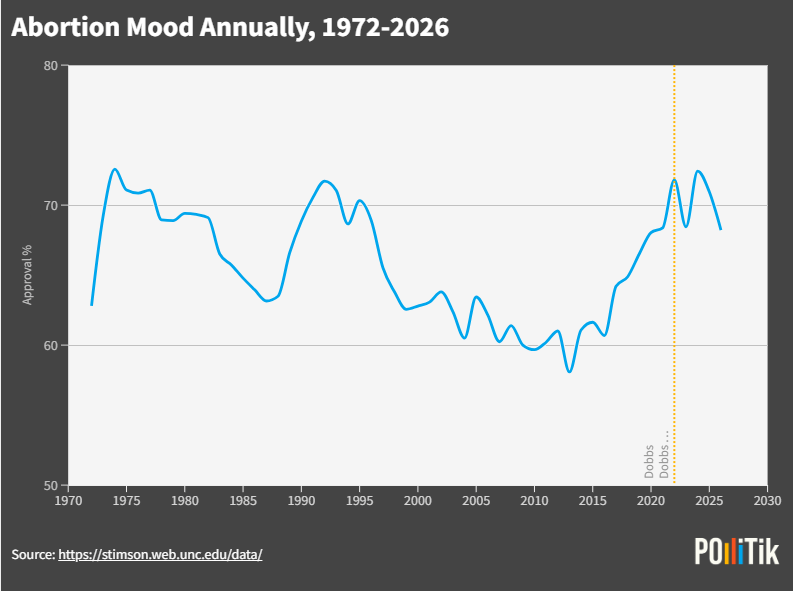
Stimson Abortion Mood Dataset 1972-2023, estimated using the dyads-ratio algorithm with updated data for 2024-2026
Instead, public opinion remained relatively stable after Dobbs. Support for legal abortion generally stayed higher than it had been before 2022 instead of returning to earlier levels . Although the exact percentages may differ across survey organizations due to differences in methodology or question wording, they largely move in the same direction: a gradual increase followed by steady support. Moreover, extending the series with the updated data allowed us to see whether the shifts observed immediately after Dobbs were temporary or continued over time.
Taken together, the Gallup, Pew, AP-NORC and ABC News/Washington Post data made it easier to distinguish long-term changes in public opinion from the normal variation that exists between individually surveys. Overall, the updated data suggests that abortion remains one of the country’s most politically debated issues, but public opinion has been more consistent, stable, and nuanced than public discourse and media tend to suggest. While the debate has become increasingly polarized and partisan-aligned, the broader public mood appears to have shifted gradually toward greater support for legal abortion while remaining relatively stable over time.
Issue Evolution: Slow & Steady
As a whole, data for public opinion and historical context of abortion views between political parties reflect broad social transformations in America over time - though there have been notable shifts in attention and engagement on the topic, the overall trend suggests that public mood has evolved gradually, over time, as newer generations with different social values become a larger share of our electorate.
Stimson argues in Tides of Consent that policy mood changes gradually rather than shifting permanently overnight after a single event. Drawing on the idea of thermostatic change, he explains that public opinion responds to and is driven by variables such as: political events, issue framing, social conditions, religious affiliation, polarization, and reactions to policy changes. This helps explain why landmark decisions such as Roe v. Wade and Dobbs v. Jackson Women’s Health Organization did not produce the dramatic shifts that many people expected. Instead they became part of a much longer process in which Americans gradually adjusted their views, while Abortion, in tandem, became increasingly tied to partisan identities.
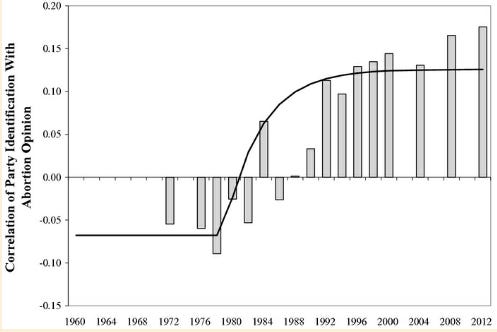
Correlations Between Partisanship and Abortion Attitudes: National Election Studies, 1960 to 2012
Stimson, James A.. Tides of Consent: How Public Opinion Shapes American Politics, Figure 3.3 (p. 67). Cambridge University Press. Kindle Edition.
As Stimson notes in Figure 3.2. Case 3, abortion has become increasingly aligned with partisan identities over time, making it a more stable political issue in comparison to decades earlier. Our updated series suggests that this gradual evolution has continued. Although abortion remains one of the country’s most politically debated issues, support for more liberal abortion policy has remained relatively stable after Dobbs, even as the tension surrounding the issue has intensified.
During her celebration of life, Adriana Monet Smith was described as a dedicated nurse who loved to travel, loved her family, and brought much joy to the people around her. It can be easy to fall into the mundane lull of policy issues in America, wrought with seemingly deep divides and never-ending politicization. A story like Adriana’s is one worth zooming into, and then out of, to find the fuller and more complete picture of how and why public policy mood ebb and flows matter.

 | A guest post by
|
 | A guest post by
|