

How do government shutdowns affect presidential approval?
Comparing shutdowns under Clinton, Obama & Trump

From 1995 to 2025, the US government experienced 4 major shutdowns under 3 presidents (Bill Clinton, Barack Obama, and Donald Trump). Government shutdowns occur when an appropriations bill cannot be agreed on between the house of Congress and the executive to fund the government. They end either when a compromise is reached or when holdouts stop holding out.
How do shutdowns influence Americans’ support for the president? Are presidents stronger or weaker in the aftermath?
Bill Clinton: 1995-1996 shutdown
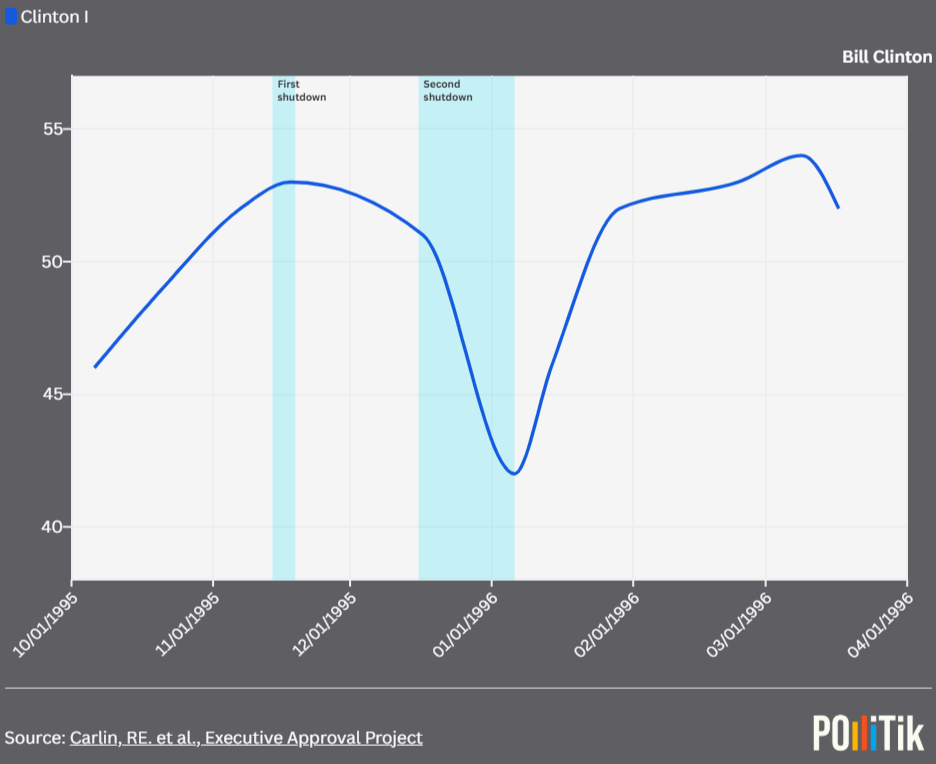
The two shutdowns during Bill Clinton’s presidency revolved around the question of whether and how to balance the budget. Republicans preferred welfare cuts and tax decreases for the wealthy while Clinton preferred to increase spending in anticipation of economic growth.
The 1st government shutdown in November 1995 ended the upward trend of Clinton’s approval that peaked at 53%. Thereafter, it continued to decline and plummeted during the 2nd shutdown to 42%.
The government ultimately reopened in January 1996 with the passage of a budget-balancing agreement between the Democrat president and the GOP-dominated Congress. Clinton’s approval rating quickly rebounded to 54% in less than one month.
The dramatic drop and recovery in Clinton’s approval were thanks to factors below:
The shock of the first long-term shutdowns in US history
The government shutdowns under the Clinton administration lasted a total of 27 days, before which the shutdowns were only a day or two. Two longer shutdowns occurring back-to-back caused surprise and anxiety among Americans, in turn affecting their confidence in the government.
The halted public services
The 1995-1996 shutdown was the first time Americans experienced inconvenience from the prolonged delay in public services, increasing their dissatisfaction with the administration. All national parks and social security offices were closed. Federal loans and grants were delayed. The cleanup of toxic waste at hundreds of sites was halted. New patients were not accepted at the National Institutes of Health Clinical Center, and thousands of new Medicare applicants were turned away daily.
The bipartisan solution
The post-shutdown rebound in Clinton’s approval was in part associated with an agreement between Clinton and the GOP-led Congress to balance public budget in a way that accommodate both parties’ interests. This bipartisan decision met public desire, as 62% of Americans found balancing the budget very important according to Pew research.
Public blame on Republicans
The Public did not blame Clinton for the shutdown. Polling during the shutdown indicated that 49% of respondents blamed Republicans in Congress while 26% blamed president Clinton. The fear of the public blame for the shutdown and the oncoming presidential elections made Republicans accept Clinton’s budget proposal.
Positive economic prospects
When the government shut down in 1995, the economy was booming, and unemployment rate was declining. Though the estimated cost of the two shutdowns come to $400 million, the economic impact was only temporary as the boom lasted until early 2000s. The ongoing economic prosperity led people to move forward from their dissatisfaction with the shutdowns.
Barack Obama: 2013 shutdown
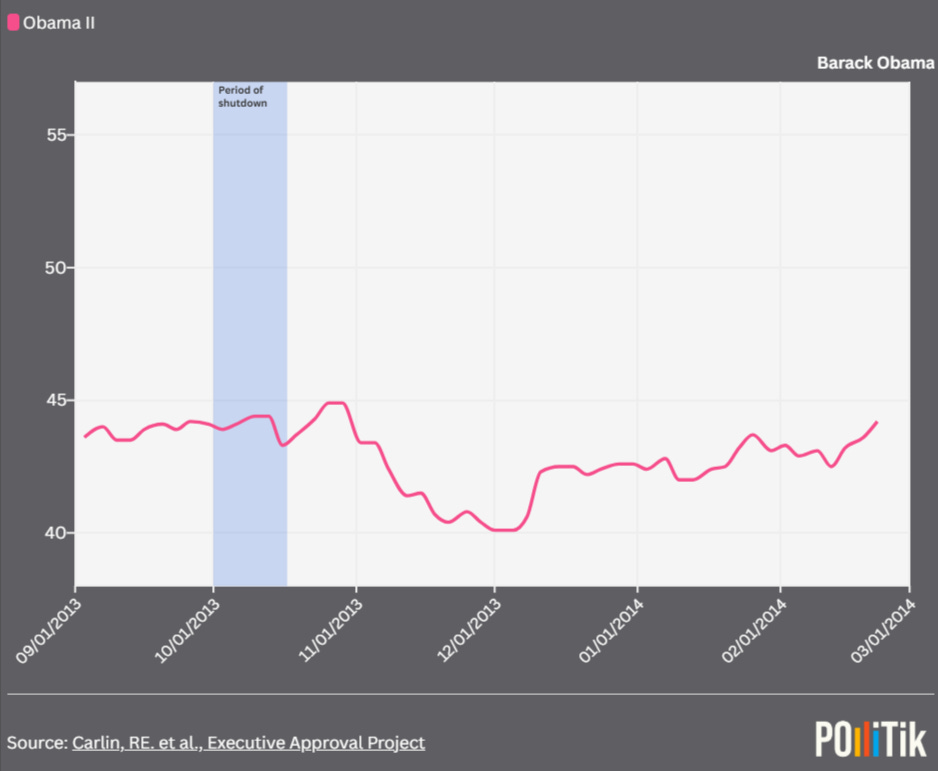
The 2013 shutdown occurred when President Barack Obama and congressional Republicans failed to reach an agreement on the federal budget, primarily due to disputes over funding for the Affordable Care Act (ACA). As partisan conflict escalated and the prospect of a shutdown grew, public anxiety increased and Obama’s previously steady approval rating began to decline.
Obama’s approval had dropped to 43% by the time the shutdown ended. Although congressional Republicans received most of the blame for the standoff, Obama was not completely insulated from public frustration. After a Senate compromise reopened the government, Obama’s approval recovered temporarily to 45% before it eroding to and remaining below pre-shutdown level for several months.
Three major factors shaped the decline and the short-lived recovery in Obama’s approval:
Disrupted Federal Services
The shutdown produced widespread inconvenience as government services halted, leaving millions without access to essential programs and furloughing federal workers without pay. These disruptions heightened economic anxiety and contributed to declining confidence in Washington. While Republicans were blamed more heavily, many Americans viewed the situation as reflective of broader governmental dysfunction, which negatively affected Obama’s approval.
Affordable Care Act Rollout Failures
The shutdown coincided with severe technical troubles in the ACA rollout, amplifying public frustration. Reports of website failures, enrollment barriers, and individuals’ prospect of losing essential insurance plans undermined trust in the administration at a critical moment. Although Obama experienced a brief approval bump after the shutdown ended and services resumed, persistent ACA problems quickly erased this recovery.
Weak Economic Environment
The shutdown took place during a period when the economy was still struggling to recover from the 2008 financial crisis. Federal spending cuts, slow economic growth, and concerns about social security and economic stability shaped public sentiment throughout 2013. These unfavorable economic conditions weakened Obama’s ability to sustain any post-shutdown gains and reinforced declining confidence in his leadership.
Donald Trump’s 1st term: 2018-2019 shutdown
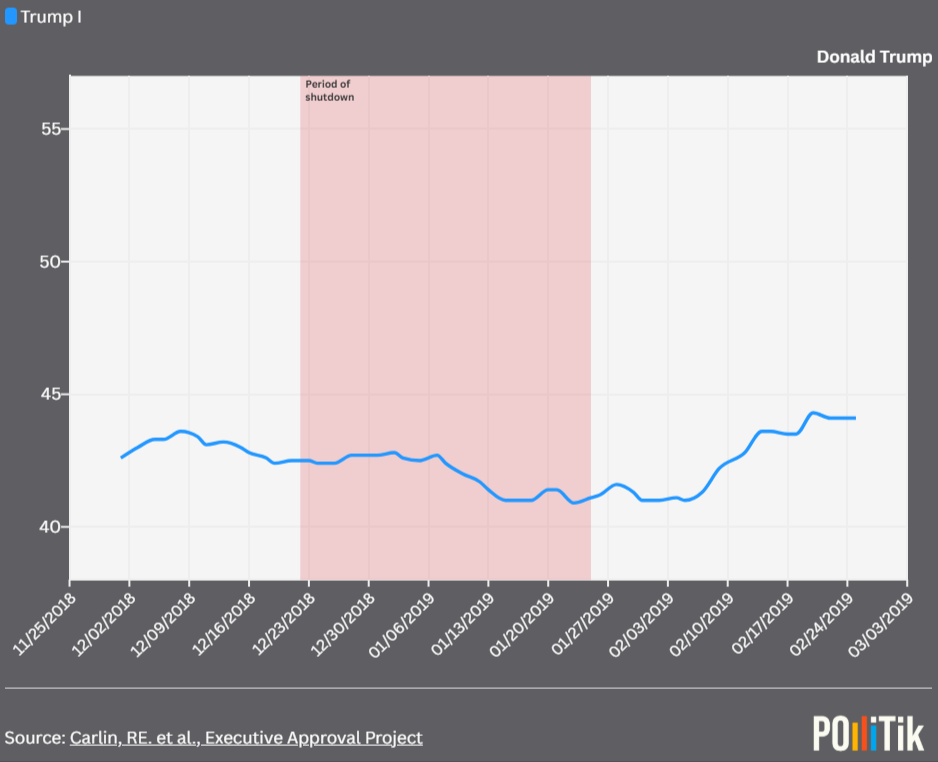
The 2018 shutdown started with the unanimous passage of a regular budget appropriations bill in the Senate that Trump unexpectedly opposed on its way to the House, arguing it lack funds for the construction of a wall along the southern border with Mexico. Once the House passed an appropriations bill with funding for the wall, Senate Democrats filibustered it. After 35 days of stagnation, a compromise bill was passed that provided $1.375 billion for a fence along the border.
Trump’s approval stayed above 42% during the first half part of the shutdown but fell to about 40% by the shutdown’s end. Afterwards, Trump’s popularity rose to 44% within a month.
There are three factors behind the drop and the rebound:
Public disapproval of the shutdown
A CBS News poll in January 2019 found that 71% of Americans considered the border wall agenda “not worth the shutdown.” Polling during the shutdown indicated that 46% of respondents said Trump versus 35% said congressional Democrats deserved the most blame.
Limited impact on the public
Trump’s post-shutdown recovery is a product of limited real impact on the public. Welfare programs, including Supplemental Nutrition Assistance Program (SNAP) and healthcare services, were not directly impacted by the shutdown due to emergency funding being used or year-long funding being secured.
Distraction with immigration issue and economy
Following the shutdown, Trump immediately tried to declare an emergency to pull even more funding towards the border wall. This possibly led to a period where his polling numbers improved to pre-shutdown levels as his conservative base approved him for standing firm on immigration issue.
Furthermore, the 2018 shutdown coincided with a generally improving economy, lowering inflation, and booming job market. People’s positive perception of Trump’s economic handling led them to tolerate the shutdown.
Donald Trump’s 2nd term: 2025 shutdown
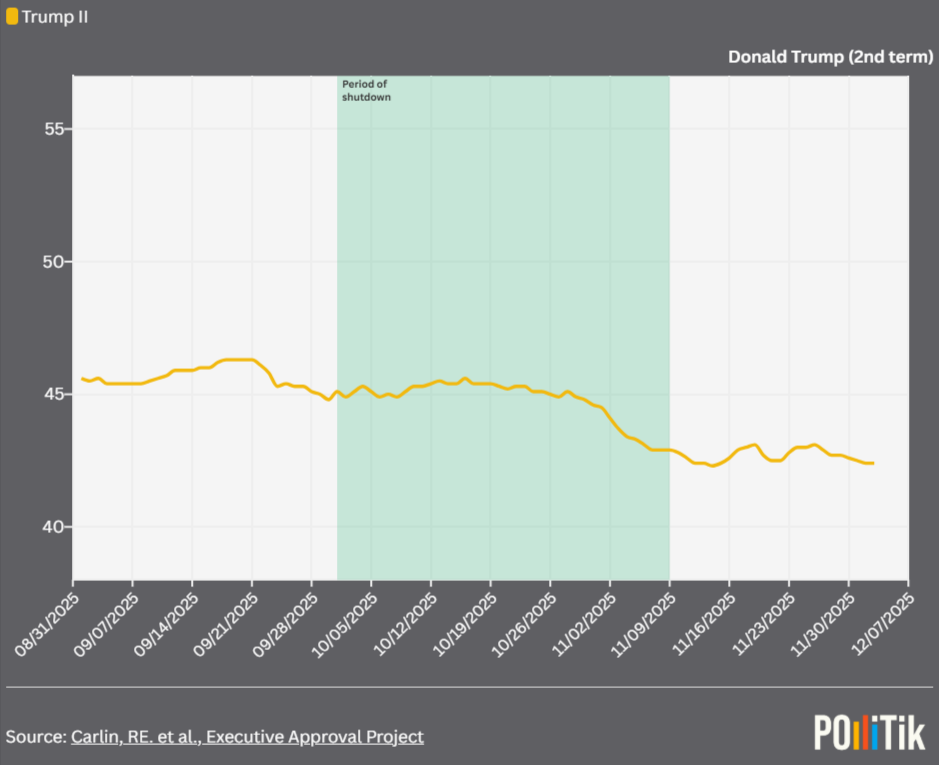
The 2025 shutdown was triggered when President Trump and Congress failed to agree on how to fund the government for the 2026 fiscal year. It was resolved when Trump signed a 3-bill package securing full-year funding for agriculture, military construction, veterans, and Congress itself and short-term funding for the rest of the federal agencies until January 30, 2026.
Within the 10 days before the 2025 government shutdown, Trump’s approval trended downward but stayed above 45%. It 43% when it ended. After the government reopened, Trump’s approval fell further to 42.4% and has remained below the pre-shutdown level, behind which there are 3 factors.
Weakening economy
Unlike the 2018 shutdown, the 2025 shutdown concurred with stagnant economy, deteriorating inflation, and declining job market. RealClearPolling shows lower shares of Americans approving Trump’s handling of economy (39.8%) and inflation (34.7%) than his overall job approval (43%) on average. The shutdown is projected to worsen an already struggling economy, with GDP growth in the 4th quarter of the year forecasted to be negative.
Endangered healthcare subsidies
Unlike the 2018 shutdown that spared funding for the Department of Health and Human Services (HHS), the 2025 shutdown risks healthcare affordability. The package to end the shutdown does not include the extension of the enhanced Affordable Care Act (ACA) subsidies that will expire on December 31, 2025. This signals skyrocketing prices for health insurances.
Political scandal
The Jeffrey Epstein files drew increasing public attention and criticism during the government shutdown. Trump and his GOP allies were reluctant to support the release of the files. A recent Reuters/Ipsos poll showed that Republicans approved of Trump’s handling of the Epstein files (44%) far less than of other issues (82%).
Frustration over the mishandling of economy, Medicaid, and Epstein files may undermine Trump’s ability to rally support and distract the public with his populist rhetoric as he has done in his first term.
Conclusion: The path of Trump’s post-shutdown approval
After comparing factors that shape patterns of pre- and post-shutdown approvals of previous presidents, we project that Trump’s post-shutdown approval is less likely to rebound significantly and may resemble Obama’s short-lived recovery followed by further decline. This can be explained with the pathways of government shutdown’s influence and the solution each shutdown delivers.
Government shutdowns affect presidential approval through direct and indirect pathways:
Direct pathways: Government shutdown directly delays federal services Americans depend on daily, triggering widespread dissatisfaction and complaints that cause people to question the government’s ability to serve. Such effects are usually temporary and would die down as the government and services get back on track.
Indirect pathways: On the other hand, government shutdown may reinforce the effect of other political, social, and economic issues on presidential popularity.
Clinton and Trump’s 1st term saw substantial and long-term recovery in their approvals, in part because their governments were shut down when the economy was improving.
Obama’s short-lived rebound in his post-shutdown approval was partly due to the sluggish economy in 2013.
Americans tend to forgive their presidents for the shutdown if they perceive the latter’s positive handling of the economy. Trump may become less forgivable to voters who were disappointed with his failure to effectively fix economy and inflation.
Dissatisfaction with government shutdown amplifies voters’ attention to the issue of politicians’ misbehaviors. The delay in the house’s vote on Epstein files due to the 2025 shutdown sparked stronger public pressure and criticism among liberals and conservatives, forcing Trump and the GOP to approve the files’ release shortly after the shutdown. The information released are likely to hurt their public image.
The sustainability of the solutions delivered that end government shutdown also underpins Americans’ evaluation of the executive performance.
The 1995-1996 shutdown ended with a bipartisan agreement setting groundwork for the 1997 balanced budget act and a budgetary surplus in 2002.
The 2025 shutdown ended with short-term funding for most federal agencies and disregards the public demand for healthcare subsidies.
The stand-alone effect of government shutdown is temporary, but it can worsen other issues with long-term effects on presidential approval. The current upheavals could pose obstacles to Trump’s retrieval of popularity in the upcoming months.
Team:
Yu Nong
Valentine Morrison
Hala Altayyar
Sources:
Pelosi has edge over Trump on budget negotiations, CBS News poll shows
https://www.cbsnews.com/news/pelosi-has-edge-over-trump-on-budget-negotiations-says-cbs-news-poll/
1995 and 2013: Three differences between two shutdowns
https://www.cnn.com/2013/10/01/politics/different-government-shutdowns
What is a government shutdown?
https://www.brookings.edu/articles/what-is-a-government-shutdown-and-why-are-we-likely-to-have-another-one/
President Trump Approval - Economy
https://www.realclearpolling.com/polls/approval/donald-trump/issues/economy
President Trump Job Approval
https://www.realclearpolling.com/polls/approval/donald-trump/approval-rating
Government Shutdown Concluded but ACA Subsidies in Limbo
https://www.ajmc.com/view/government-shutdown-concluded-but-aca-subsidies-in-limbo#:~:text=Despite%20that%2C%20the%20bill%20passed,than%20double%20for%20some%20individuals.
Republicans give Trump weak marks on Epstein files
https://www.reuters.com/investigations/republicans-give-trump-weak-marks-epstein-files-2025-11-21/
Clinton Ratings Hold: Balanced Budget A Public Priority, But Few See Personal Payoff
https://www.pewresearch.org/politics/1996/01/18/clinton-ratings-hold-balanced-budget-a-public-priority-but-few-see-personal-payoff/#:~:text=Nonetheless%2C%20a%20balanced%20budget%20is,for%20the%20House%20next%20fall.
Government Shutdown Effects on Public Health: Lessons from the 2025 and 2018-2019 Closures
https://www.astho.org/communications/blog/2025/government-shutdown-effects-on-public-health/#:~:text=The%202018%2D2019%20shutdown%2C%20which%20was%20sparked%20over,agencies%20%E2%80%94%20including%20CMS%2C%20CDC%2C%20HRSA%2C%20and
House and Senate on collision course as shutdown nears
https://www.politico.com/story/2018/12/20/border-wall-funding-house-1070940
Mitch McConnell blocks Senate Democrats’ move to reopen government
https://www.cnn.com/2019/01/10/politics/senate-blocks-vote-congress-shutdown/index.html
As Congress Passes Spending Bill, Trump Plans National Emergency to Build Border Wall
https://www.nytimes.com/2019/02/14/us/politics/trump-national-emergency-border.html
Poll: Majority of Americans hold Trump and Republicans responsible for shutdown
https://thehill.com/homenews/campaign/427007-poll-majority-of-americans-hold-trump-and-republicans-responsible-for/
Trump says he could keep shutdown going for months or years
https://www.cnn.com/2019/01/04/politics/shutdown-donald-trump-nancy-pelosi/index.html
Obama’s Job Approval Declined Steadily Throughout 2013
https://news.gallup.com/poll/166727/obama-job-approval-declined-steadily-throughout-2013.aspx
Poll: 72 percent opposing shutdown over Obamacare
https://www.usnews.com/news/articles/2013/10/01/poll-72-percent-oppose-shutdown-over-obamacare
Obama’s approval rating match two-year low, the poll shows
https://www.nytimes.com/2013/09/26/us/politics/obamas-approval-rating-matches-two-year-low-poll-shows.html
Who Americans Usually Blame After Showdowns Over Federal Spending
https://fivethirtyeight.com/features/government-shutdown-polls/