

Going Out On Top
Approval Ratings of Leaders Who Died In Office

Introduction
When a political leader dies in office, how does the public respond? Public reactions can vary depending on several factors, including the cause of death, the leader’s popularity before their death, and the political climate at the time. By examining leaders who died from assassination, illness, and sudden medical emergencies, we explore how different circumstances surrounding a leader’s death may influence executive approval and public support for their successors.
Here we focus on four world leaders from different continents and political systems to see what patterns emerge.
USA
President John F. Kennedy was assassinated on November 22, 1963, in Dallas. At 12:30 PM, while President Kennedy was riding in an open-top motorcade, suspect Lee Harvey Oswald fired shots from the sixth floor of the Texas School Book Depository. At 1:00 PM, President Kennedy was pronounced dead at Parkland Memorial Hospital.
In his final quarter, his presidential approval rating was 49.5%, which was a 1-point drop from the previous, and a full 5-point fall from the rating two quarters prior (see Figure 1). When Lyndon B. Johnson took office, there was a rally in popularity, with approval increasing to 53.5% following JFK’s death (see Figure 2. The assassination led to a wave of emotion that accelerated policy and consolidated public support for Democrats.

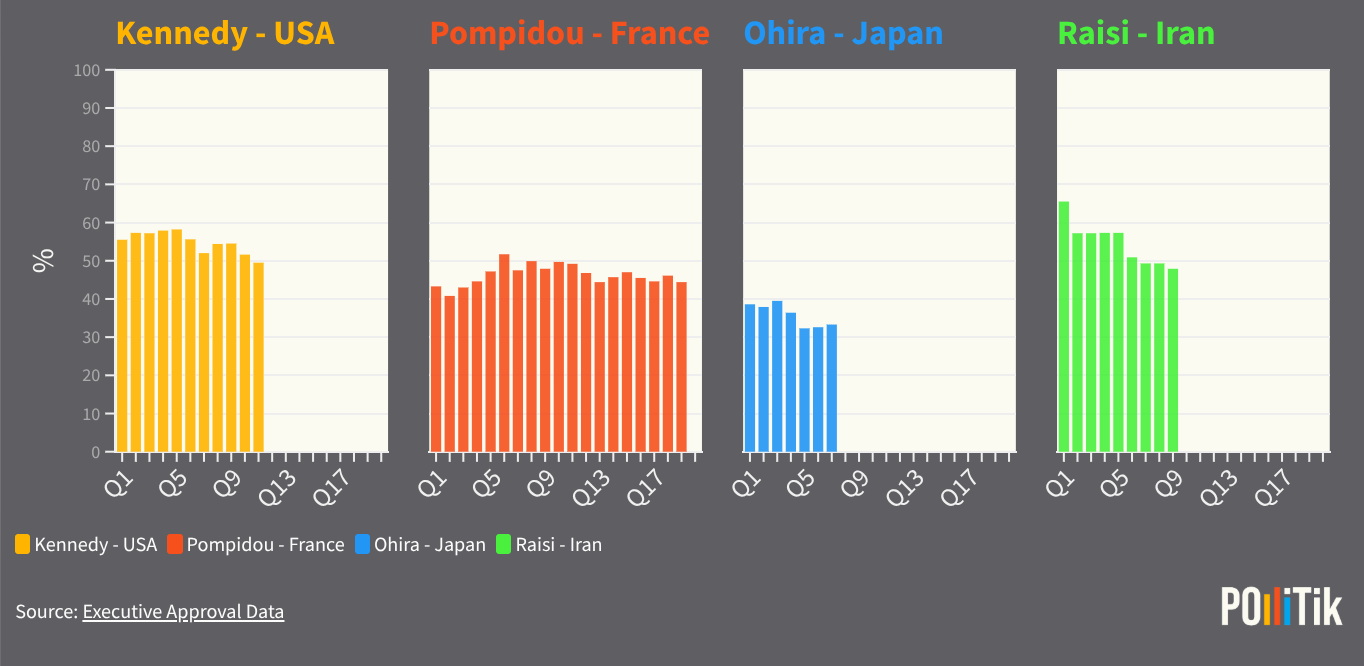
Figure 1. These graphs display the quarterly approval ratings of each deceased leader during their time in office.
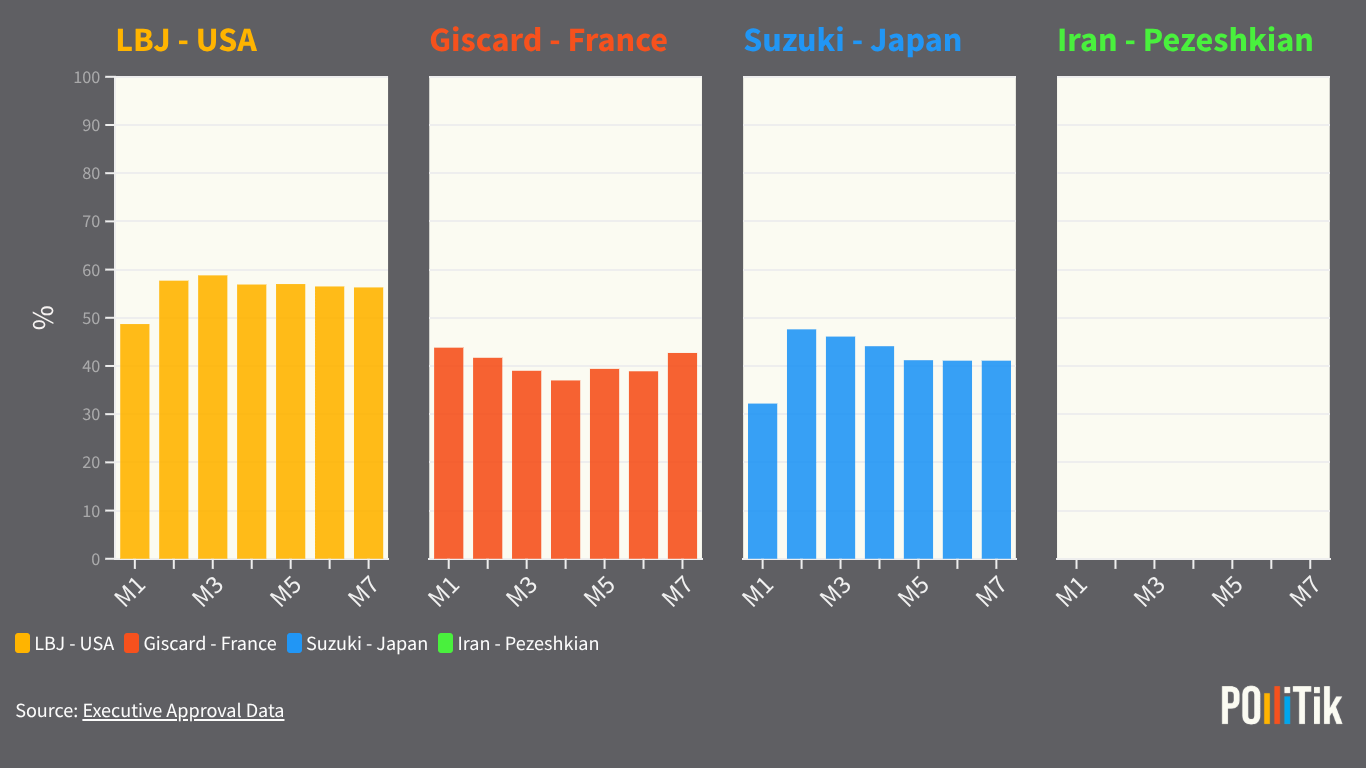
Figure 2. These graphs display the monthly approval ratings of each deceased leader’s successor. For reference, the series begins with the predecessor’s approval rating in the final month of his tenure. (There is no data available for Iranian successor Masoud Pezeshkian.)
France
President Georges Pompidou died from Waldenstrom’s macroglobulinemia, a rare type of blood cancer. He passed away on April 2, 1974, at the age of 62. His presidency ran from June 20, 1969, to April 2, 1974.
In his final quarters public approval was fairly flat and in the mid-40’s—no rally was evident (see Figure 1). This may be because he died from natural causes rather than from a sudden event. In the months before his death, there were rumors about his condition, and he appeared in public less frequently, which may have prepared citizens for a change in leadership.
Monthly approval decreased from 43.8% to 41.7% after interim President Alain Poher took over. After official elections, President Giscard began his tenure with an approval rating of 39%. By September 1974, Giscard’s approval had risen to 47.7%. (see Figure 2).
Japan
Prime Minister Masayoshi Ohira died on June 12, 1980, after suffering a heart attack while campaigning for the upcoming general election. He was 70 years old and had served as Prime Minister from December 7, 1978 to June 12, 1980.
In the final quarter before his death, his approval rating was 33.33% (see Figure 1). After his death, approval increased to 46.4% (see Figure 2), which could be explained by a sympathy rally from the Japanese public. Since his death occurred just days before the election, many citizens rallied around the Liberal Democratic Party and supported the peaceful transition of leadership.
Iran
Former President of the Republic Ebrahim Raisi died on May 19, 2024, at age 63 in a helicopter crash along with Foreign Minister Hossein Amir-Abdolahian and six other passengers and crew. His term lasted from August 3, 2021, to May 19, 2024.
At the beginning of his term, there was a honeymoon bump that pushed his approval rating from 48.1% to 65.5%. Afterward, approval steadily declined due to nationwide protests that were handled poorly by Raisi’s government, a worsening economy, tightened law enforcement, and ongoing conflict with Israel.
These factors, combined with his death, may help explain why his approval rating ended at 47.9% (see Figure 1). Lack of data prevents us from assessing how this impacted his successor’s popularity.
Conclusion
The cases examined in this paper demonstrate that executive succession following the death of a national leader can produce different political outcomes depending on institutional stability, public confidence, and the broader political environment. In the United States, France, and Japan, successor approval data allow for a comparison of public opinion during the first months of the new administration. Iran also illustrates an important transition, although comparable successor approval data were not available in the dataset used for this analysis.
Comparing the final approval ratings of outgoing leaders with the early approval trends of their successors provides a more complete understanding of executive transitions than examining either leader in isolation. Across these cases, the evidence suggests that public reactions to executive succession are shaped by more than just the death of a leader. The transition itself, the legitimacy of the successor, and broader national conditions all influence how citizens evaluate a new administration. Where comparable approval data were available, examining approval across both administrations provides a clearer picture of how public opinion evolves during one of the most consequential moments in executive politics.