

Electoral Projection: Chile
Presidential Elections: 16 November 2025

Chile’s 2025 presidential election comes at a pivotal moment in its shifting political landscape. Jeannette Jara, former labor minister and candidate for the leftist Unity for Chile coalition, secured her nomination with over 60% of the primary vote. Incumbent president, Gabriel Boric, has embraced her as his successor. She faces strong competition from the far-right from José Antonio Kast and from the center-right from Evelyn Matthei. Growing concerns over crime and migration have fueled support for hardliner like Kast, who Boric defeated in 2021. With the first round set for November 16 and a potential runoff in December, the elections are shaping up to be one of Chile’s most polarized in recent history.
Background
Chile holds presidential elections every four years, with the next election scheduled to be held on November 16, 2025. The winners of the presidential elections are determined by a direct, popular vote. In order to win an election, the candidate must have the absolute majority of electoral votes. If a candidate does not win an absolute majority in the first round of elections, a runoff election is held between the top two voter-getters. Voter registration in Chile is voluntary and, in 2012, voting was made voluntary, as well. In 2023, automatic registration was adopted and compulsory voting was reinstated. Citizens over 18 must vote or face fines, though exceptions exist for those living abroad or far from polling places. The Electoral Service (SERVEL) oversees logisticsl the Election Qualification Tribunal (TRICEL) certifies results.
Chile’s political landscape is increasingly polarized, with coalitions either moving towards far-right populism or far-left ideologies. On the surface, this reflects tensions over inequality, crime, and representation, especially in the wake of the 2019 social unrest and two failed constitutional reform attempts. At root, however, polarization stems from 2015 electoral system reforms that introduced greater proportionality.
Long-Run Forecast
Our preliminary long-term fundamentals forecast features incumbent approval ratings and annual growth rate measured six months before the election. Boric has not been popular. His ratings have a ceiling of around 40% and a floor of around 30%. Economic growth has been stubbornly low, which has not helped Boric’s standing. However, the slight increase in GDP during Quarter 2 of 2025 should is a boon to the electoral chances of his successor, Jeannette Jara.
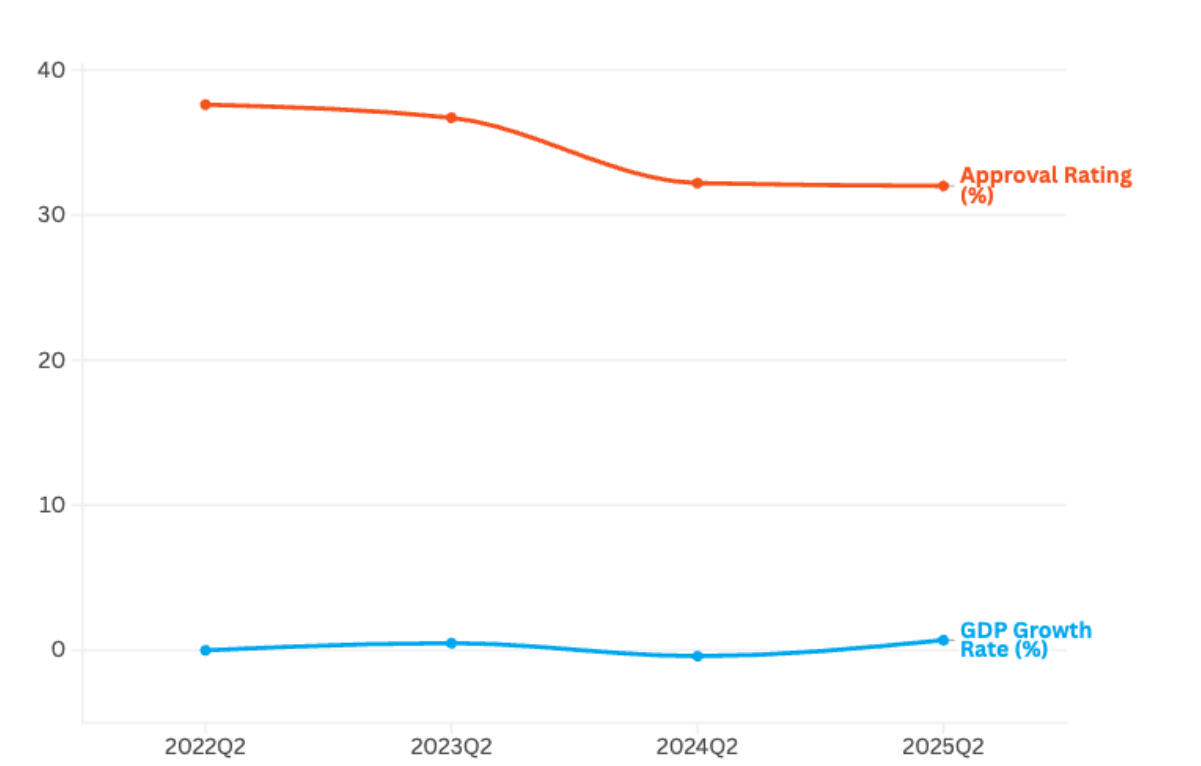
Our projection model utilizes these factors to estimate Jeanette Jara’s first-round vote share in November and overall win probability. The model projects Jara to win 32.19% of the total first-round presidential votes. This falls well short of the absolute majority required to win outright in a single round. It might not even garner her a spot in the runoff. Hence, round two be a showdown between the far-right populist, José Antonio Kast, and moderate conservative, Evelyn Matthei. Indeed, the model gives Jara 40.48% probability of Jara claiming victory over both rounds.
References
● Carlin, Ryan E., Jonathan Hartlyn, Timothy Hellwig, Will Horne, Gregory J. Love, Cecilia Martinez-Gallardo, Matthew Singer, Juan S. G. Cruces, and Hilal Sert. 2025. “Executive Approval Database.” OSF. May 13. https://doi.org/10.17605/OSF.IO/84MJX. ● Freedom House. 2024. Chile: Freedom in the World 2024. https://freedomhouse.org/country/chile
● International Foundation for Electoral Systems (IFES). 2025. Elections in Chile. https://www.ifes.org/chile
● Trading Economics. 2025. Chile GDP Annual Growth Rate. https://tradingeconomics.com/chile/gdp-growth Fundamentals Model
Model
The long-run fundamentals forecasts are tailored to contexts with few elections. Our method consists of three steps. First, we pool election outcomes for incumbent and incumbent successors across roughly two dozen presidential democracies. Second, we leverage a machine-learning technique called LASSO to select the most predictive economic and political fundamentals measured six months prior to the election. For incumbent party vote shares, this methodology indicated presidential approval, a president running for immediate reelection, quarterly growth (annualized), and indicators for Ecuador and the Philippines. Forecasts of incumbent win probability included the same variables (minus the Philippines) but with the inclusion of "Time-for-Change", a variable indicating the incumbent party seeking more than one consecutive term (per Abramowitz 1988). Finally, we employ the weights from these predictors to forecast the election outcome.
Team: Zenab Okolo, Michael Bridges, Rachel Altman, Maya Hamdi, Alioune Lo