

ELECTORAL PROJECTION: HONDRUAS
Presidential Election: November 30th, 2025

Overview

Note: This article is an update of a previous election forecast for Honduras published earlier this year by Pollitik
Since winning the 2021 election, Honduran President Xiomara Castro’s approval has hovered between the high 50s and low 40s. She (along with her husband, ex-president Manuel Zelaya) has led Libertad y Refundación (AKA LIBRE), the first explicitly left-wing party to gain power in Honduras. This de facto ended Honduras’ two-party system. As Honduras doesn’t allow the president to run for reelection, Castro and LIBRE they’ve anointed ex-minister of defense Rixi Moncada to be the successor candidate. In opposition are the two traditional political parties of Honduras, Partido Nacional, the right-wing party, and Partido Liberal, the traditionally center/center-left party, which has become more centrist as LIBRE has cannibalized its left-wing support.
Tensions run high as the primary vote in the Spring saw irregularities and inconsistencies, and there are growing worries that this will carry into the election on November 30th. This election’s driving domestic issues are the economy, crime, and corruption. LIBRE has added to the social safety net, and they are popular. However, Honduras continues to have the highest murder rate in Central America & corruption continues to plague the country.
Geopolitics is also on the ballot. LIBRE decided to recognize China over Taiwan when they won back in 2021, while also being friendly to other left-leaning countries in Latin America. The Liberal party’s candidate Nasralla has already promised that if he wins, he will reverse course on these decisions and warm to the US and switch back to recognizing Taiwan, which would shock domestic markets and could have major geopolitical ramifications as well.

Background
Election, electoral system:
The president of Honduras is decided by who receives the most votes in one round. They will then serve a 4-year term after which they can’t run for reelection. The president must be natural born, be at least 30, and isn’t serving, or have served in the military or police for at least a year. Hondurans can vote when they turn 18 unless they have a criminal record. Also, members of the military can’t vote as they are charged with managing the elections.
Candidates, parties:
Nasry “Tito” Asfura - Partido Nacional (Right)
Asfura is the right-wing candidate. He represented Partido Nacional in the 2021 race, where he lost to the current president, Xiomara Castro, trailing by about 15 points in that election. He was the mayor of Tegucigalpa, the capital city & largest city in Honduras, from 2014 to 2022.
Rixi Moncada - Partido LIBRE (Left)
Moncada is running to be Xiomara Castro’s successor, representing her party LIBRE. She was a lawyer before becoming a politician. Recently, she has served as minister of finance as well as minister of defense during the current administration. There was controversy about her serving as minister of defense during the primary campaign, as the military is responsible for managing the elections. However, in the primaries, this wasn’t a major issue for her as she won with 92% of the vote.
Salvador Nasralla - Partido Liberal (Centrist)
Nasralla is representing the centrist party in this year’s election. He was the Vice President of Honduras from 2022 to 2024. Nasralla ran in both 2017 & 2021. He dropped out of the race in 2021 to become the running mate of Castro. In 2017, he officially lost; however, documents released during a corruption scandal by New York prosecutors in 2023 show he won the vote in the 2017 election with 57%.
Issues, cleavages
Corruption: Corruption in Honduras is a key issue within Honduran society. For years, the country has struggled with the intertwining of political power, organized crime, and weak institutions — a dynamic that has undermined public trust in institutions. Drug traffickers & Cartels have reportedly channeled untraceable cash into political campaigns and even assassinated some candidates. Meanwhile, the principal electoral authority (CNE) is riven by internal divisions and faces even more accusations of political interference.
Crime: Honduras’ murder rate has declined since Castro first took power in 2022, but its murder rate remains the highest in all of Central America. Cartels and gangs like MS13 have a major foothold in the country, which the state has struggled to grapple with.
Economy & Poverty: The economy has improved under the Castro administration as GDP has risen and the unemployment rate has fallen from 8 to 5 percent since she took office. However, still many of these jobs are low-skilled and low-paying, as according to the UNWFP, 63% of the country is still in poverty. This has meant that the LIBRE social programs have been popular, but cuts to them could have a major effect on the populace if either of the more conservative parties pulls ahead in the election.

LONG-TERM TRAJECTORY TREND
Our fundamentals model considers several political factors. Presidential Approval is the key factor that we consider, among other things, such as reelection and party type. Given that reelection is not possible, the results of our forecast equation are applied to the successor; in this case, Moncada, given Castro’s endorsement.
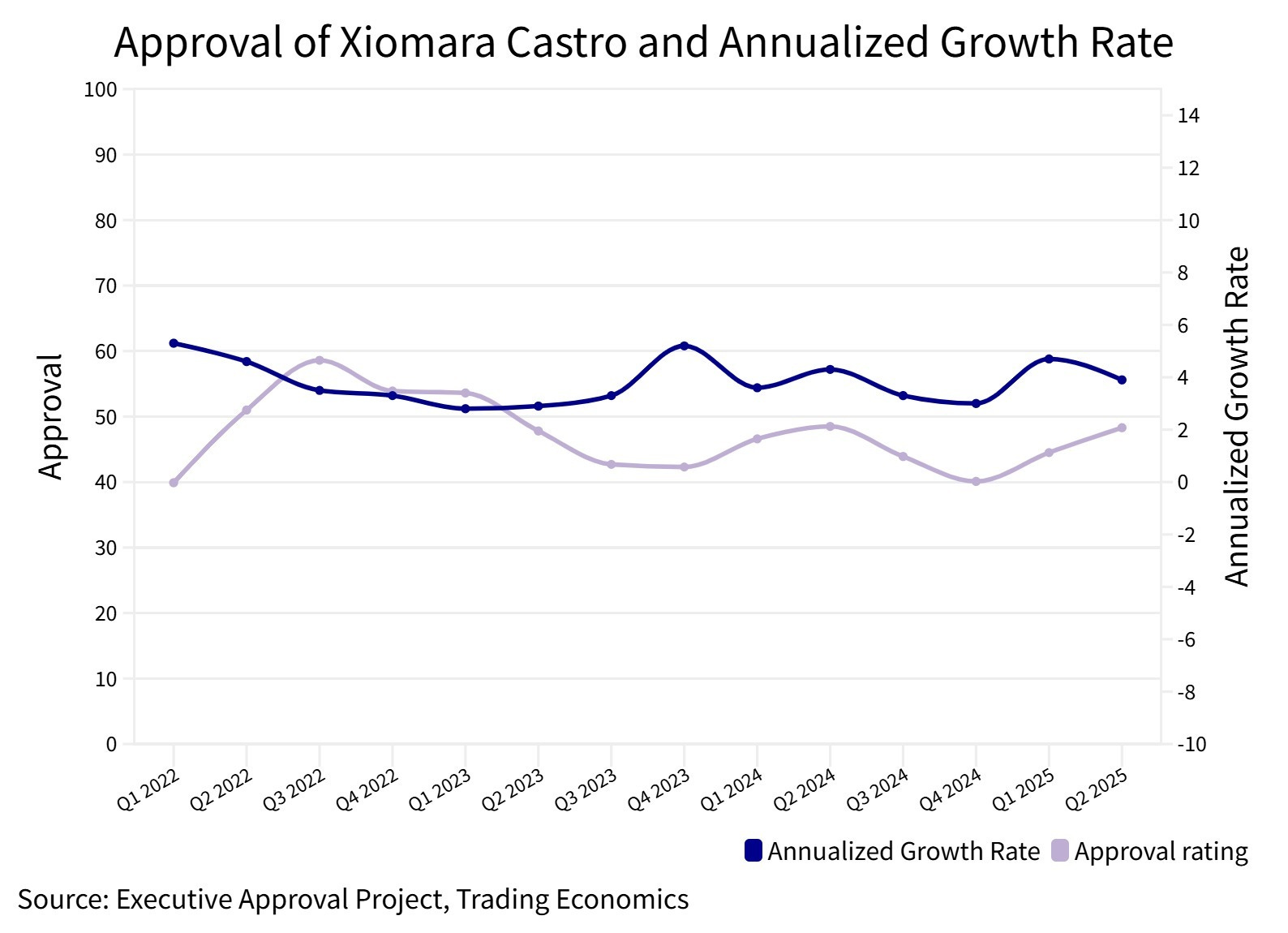
According to estimates from the Executive Approval Database, Castro during her honeymoon period her approval peaked in the high 50s. Since then, however, it has cooled down with her approval hovering between the low & high 40s.
According to Pollitik’s election forecast, we give Moncada around a 55% chance to win in the presidential election on the 30th.

FINDINGS
Most likely scenarios
Winner(s): Rixi Moncada & LIBRE look to be winners for the upcoming election, as it looks like they will hold onto power for another term. Rixi Moncada is likely to become Honduras’s second female president. This will allow LIBRE to continue to further their agenda and entrench themselves in national politics, as they are a relatively new party founded only in 2011 and will have won the presidency twice since then.
Outlook (governance/economy): Hondurans will benefit from LIBRE’s expanded social programs and some anti-corruption measures taken. A Moncada election may mean some uncertainty for international investors. LIBRE’s confrontational politics and skepticism of institutions, combined with left-leaning economic views, have already seen international investment slow down in Honduras; another LIBRE term with a slowing economy worldwide could see this trend continue. But a continuation of the LIBRE financial management & social program, along with potential foreign investment from China, could strengthen public trust in the government.
Losers (political landscape): Asfura & Nasralla would both be the biggest losers. For Asfura, this would be the second time he’d have lost to LIBRE, and he would’ve been out of office as the mayor of Tegucigalpa for 4 years, which would make it an uphill battle to get himself into a position to run for president again. For Nasralla, he cut himself loose from the Castro administration when he was Vice President, and much of the anti-corruption achievements he has campaigned on would have been achieved by the administration he left, leaving behind the credit with them. This may dampen his own political prospects as he would’ve seen himself on the outside of the president’s office three cycles in a row, which may kill his own political career.

MORE INFORMATION
Data sources
Executive Approval Project
Gallup World Poll
IPSOS-MORI
UNWFP
Borge y Asociados
Trading Economics
AmericasBarometer
Latinobarometer
Diario Paradigma
M&R Consultores
Methods
Fundamentals model. The long-run fundamentals forecasts are tailored to contexts with few elections. Our method consists of three steps. First, we pool election outcomes for incumbent and incumbent successors across roughly two dozen presidential democracies. Second, we leverage a machine-learning technique called LASSO to select the most predictive economic and political fundamentals measured six months prior to the election. For incumbent party vote shares, this methodology indicated presidential approval, a president running for immediate reelection, quarterly growth (annualized), and indicators for Ecuador and the Philippines. Forecasts of incumbent win probability included the same variables (minus the Philippines) but with the inclusion of “Time-for-Change”, a variable indicating the incumbent party seeking more than one consecutive term (per Abramowitz 1988). Finally, we employ the weights from these predictors to forecast the election outcome.
See Love, Carlin, and Singer (2025) for more details on the methodology.
Team
Javier Torres
Victoria Cook
Willow Shoffeitt
Eduard Karpoev
Coverage
Honduran Presidential (November 30th, 2025)