

ELECTORAL ANALYSIS: COSTA RICA
Presidential elections 1 February 2026


OVERVIEW
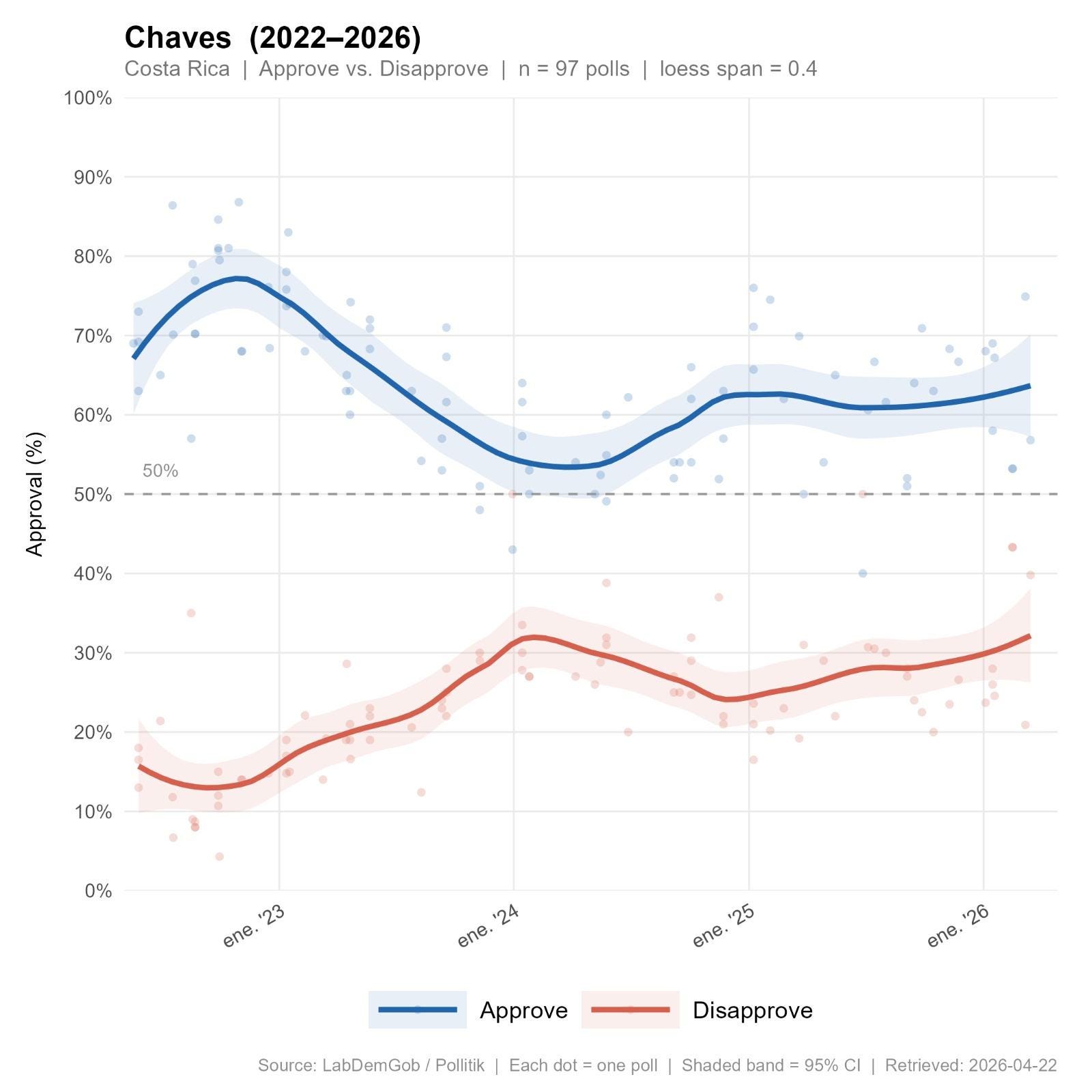
Between 2022 and 2026, Costa Rica experienced a significant departure from its historical presidential approval patterns. President Rodrigo Chaves maintained an average approval rating above 40%, positioning him as the country’s most popular president in recent history. Unlike his predecessors, whose support often collapsed after an initial “honeymoon” period, Chaves demonstrated a unique resilience, with a disapproval rating that never outnumbered his approval.
The central explanation for this trend lies in Chaves’s ability to position himself as a reform-oriented alternative to traditional political parties, combined with a populist communication style that resonates in rural and coastal provinces. While economic and security shocks caused a temporary dip in support in early 2024, his administration entered its final year with a stable mandate, signifying a potential shift in the country’s long-term governability.

BACKGROUND
Elections and institutions
Rodrigo Chaves’s rise to the presidency was anything but a landslide. Emerging from a crowded multi-party field in 2022, he squeezed into the second round representing the newly formed Social Democratic Progress Party (PPSD) after securing just 16.7% of the initial vote. While he eventually claimed the presidency in April with 52.8% of the valid votes, a staggering 42% abstention rate initially cast a shadow over the breadth of his popular mandate. This fragile beginning meant Chaves entered the Casa Presidencial not with a blank check from the public, but with a mandate that was viewed as shallow and vulnerable to the immediate scrutiny that typically follows a narrow runoff win.
Politicians and parties
Rodrigo Chaves entered office leading the Partido Progreso Social Democrático (PPSD), a newer conservative party founded in 2018 and known for its reform‑oriented, security‑minded, and confrontational style. This contrasted sharply with earlier presidents like Carlos Alvarado and Luis Guillermo Solís of the more progressive PAC, and Laura Chinchilla and José María Figueres of the center‑left PLN, both long‑dominant left-leaning and progressive parties. Over time, PAC and PLN lost public favor as many voters associated them with rising crime, fiscal strain, corruption scandals, and persistent economic inequality. They did very little to address these issues and implemented very little change, which created space for a more conservative figure like Chaves to speak to the issues of the people and gain the support of the majority.
3. Social and economic background
While Costa Rica remains a regional economic leader, the “Pura Vida” image is currently being tested by a tightening fiscal rule and a record-breaking surge in organized crime. The security crisis, marked by peaking homicide rates in 2023 and 2024, has become a significant shock to the national psyche and a potential landmine for any administration’s popularity. This tension has exposed a deepening geographic rift: Chaves maintains a populist stronghold in rural and coastal provinces, while the urban middle class and intellectuals of the Central Valley have largely moved into the opposition. This polarization has forced the president to lean heavily into populist communication strategies to maintain his favor in the face of deep institutional resistance.

POPULARITY
1. Pattern description: levels, stability, and volatility
Chaves’ popularity remains very high for the majority of his duration in office with little volatility seen throughout most of his term. We see a strong honeymoon effect lasting through the first year of term, with a high reaching nearly 80% approval. Even after his honeymoon phase, Chaves managed a very high approval rating. In comparison to past presidents, Chaves’ popularity is unmatched, never having an average approval rating drop below 50% and never having a disapproval rating that outnumbers the approval.
Figure 1. Presidential approval
Identification of phases
● The first phase corresponds to the honeymoon period (2022), when optimism toward the new administration was dominant. Expectations mattered more than measurable results.
● The second phase was the governing adjustment period (2023), where approval declined as institutional conflict and policy limitations became more visible.
● The third phase began in 2024 and can be described as consolidation. Instead of continuing to fall, approval stabilized and partially recovered.
● The fourth phase, covering 2025–2026, is one of late-term endurance, where approval remains favorable despite accumulated controversies and governing fatigue.
Identifying shocks and breaks
Looking at the graphs, the two breaks in Chaves’s approval fit the same pattern seen under earlier presidents, where drops usually follow visible conflict or economic stress. Alvarado fell during the fiscal‑reform protests, Solís during the Cementazo fallout, and Chinchilla during the La Trocha scandal, showing how quickly approval reacts to shocks. In that same way, Chaves’s early‑2024 drop lines up with rising institutional confrontation and worsening perceptions of security and economic stability, even though he still kept over 40% approval and remained more positively evaluated than most presidents. His small late‑2024 rebound mirrors the late‑term recoveries seen in several past administrations, driven more by shifts in public mood than major policy changes.
Comparison and Contextualization
Rodrigo Chaves held an initial 70% popularity rating in 2022. With an average popularity ranking above 40% that positions Chaves to be Costa Rica’s most popular president in recent years. Chaves was the only president in recent years to never have a disapproval rating higher than his approval rating, the only previous exception being president Oscar Arias. Chaves is also an exception in post honeymoon approval. Previous presidents like Laura Chinchilla or Carlos Alvarado saw their approval plummet post honeymoon, whereas Chaves after his honeymoon saw steady approval ratings his whole term, even seeing a slight boost in approval in his final months in office, making him a rare outlier compared to most Costa Rican presidents.
Figure 2. Presidential approval
Óscar Arias remains one of the main benchmarks of sustained presidential popularity in Costa Rica. His administration benefited from political experience, international prestige, and comparatively favorable governing conditions. Although the national context was different, Arias is one of the few presidents whose popularity can be meaningfully compared with Chaves in terms of durability. This suggests that Chaves belongs to a relatively small group of presidents capable of maintaining broad support beyond the honeymoon phase.
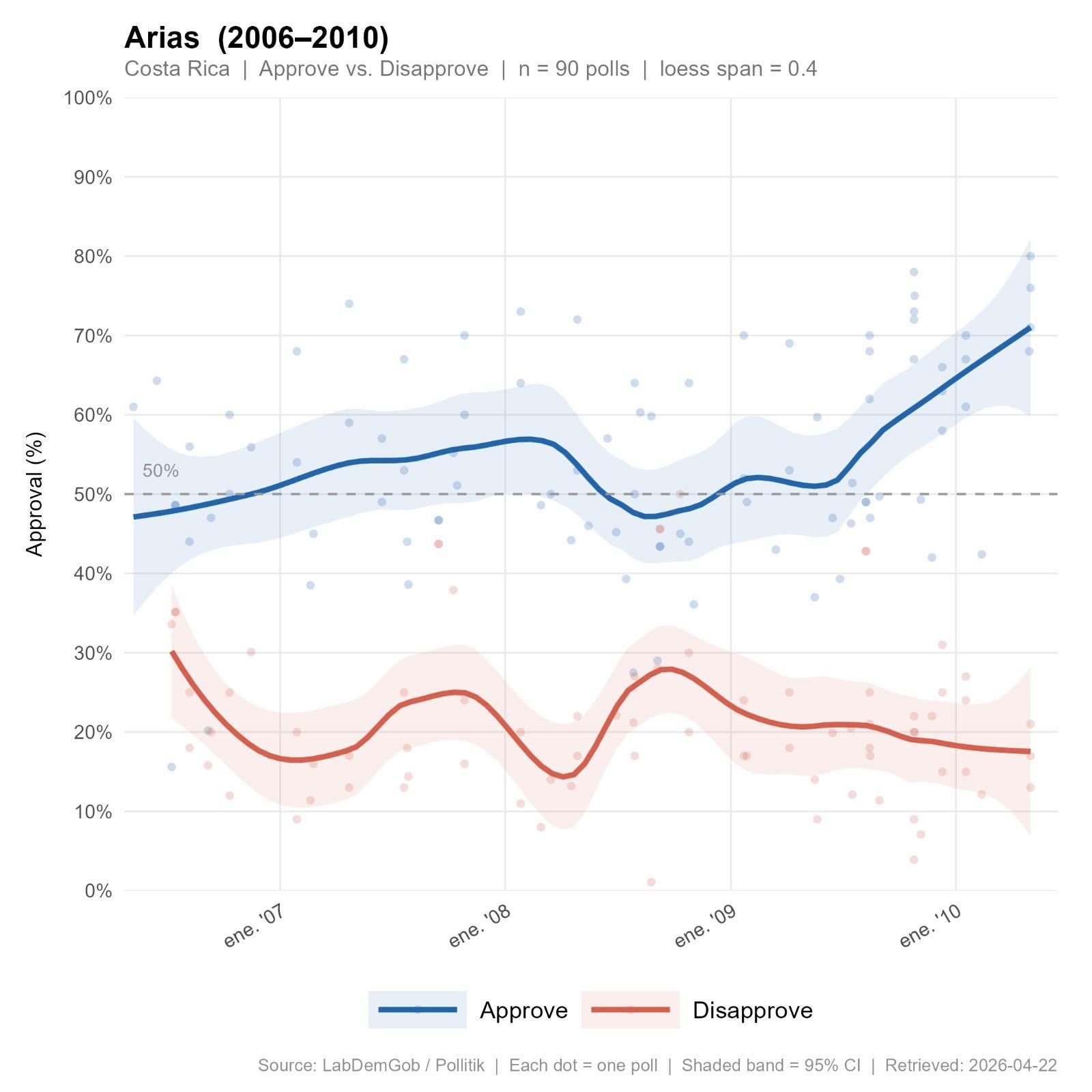
Figure 3. Presidential approval
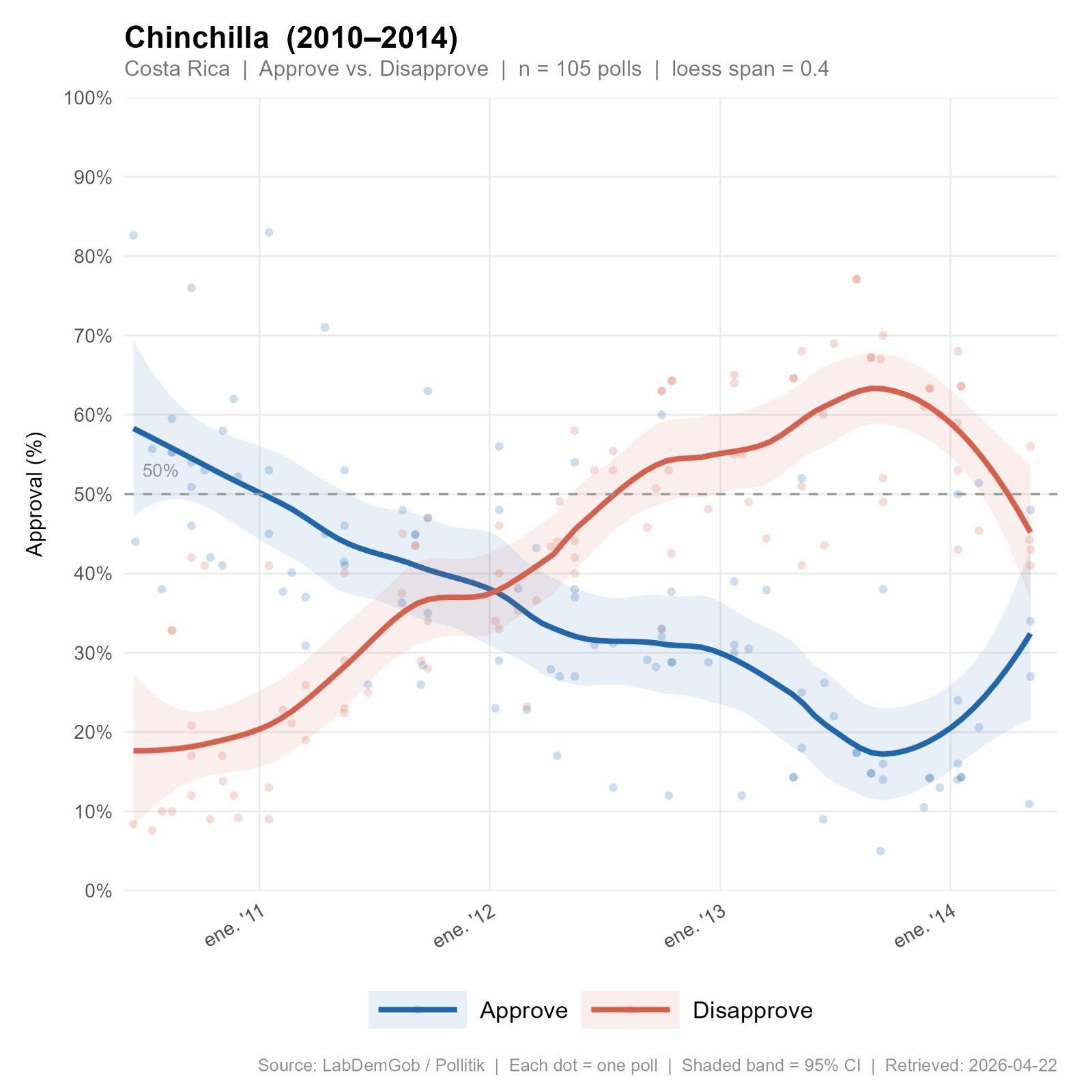
Laura Chinchilla presidency illustrates the political costs of governing under growing citizen dissatisfaction and institutional constraints. Her approval weakened considerably during the term, reflecting public frustration over management problems and declining confidence in traditional leadership. Compared with Chaves, her trajectory shows how difficult it is to maintain legitimacy once support begins to erode.
Figure 4. Presidential approval
Luis Guillermo Solís also entered office as an alternative to traditional party politics, but his approval weakened over time as governing constraints became more visible. He spent long periods below 40%, showing how difficult it is for outsider or reformist leaders to preserve public enthusiasm once in power. Chaves appears comparatively stronger because he has been more successful at converting anti-establishment rhetoric into durable backing, particularly among voters dissatisfied with traditional institutions.
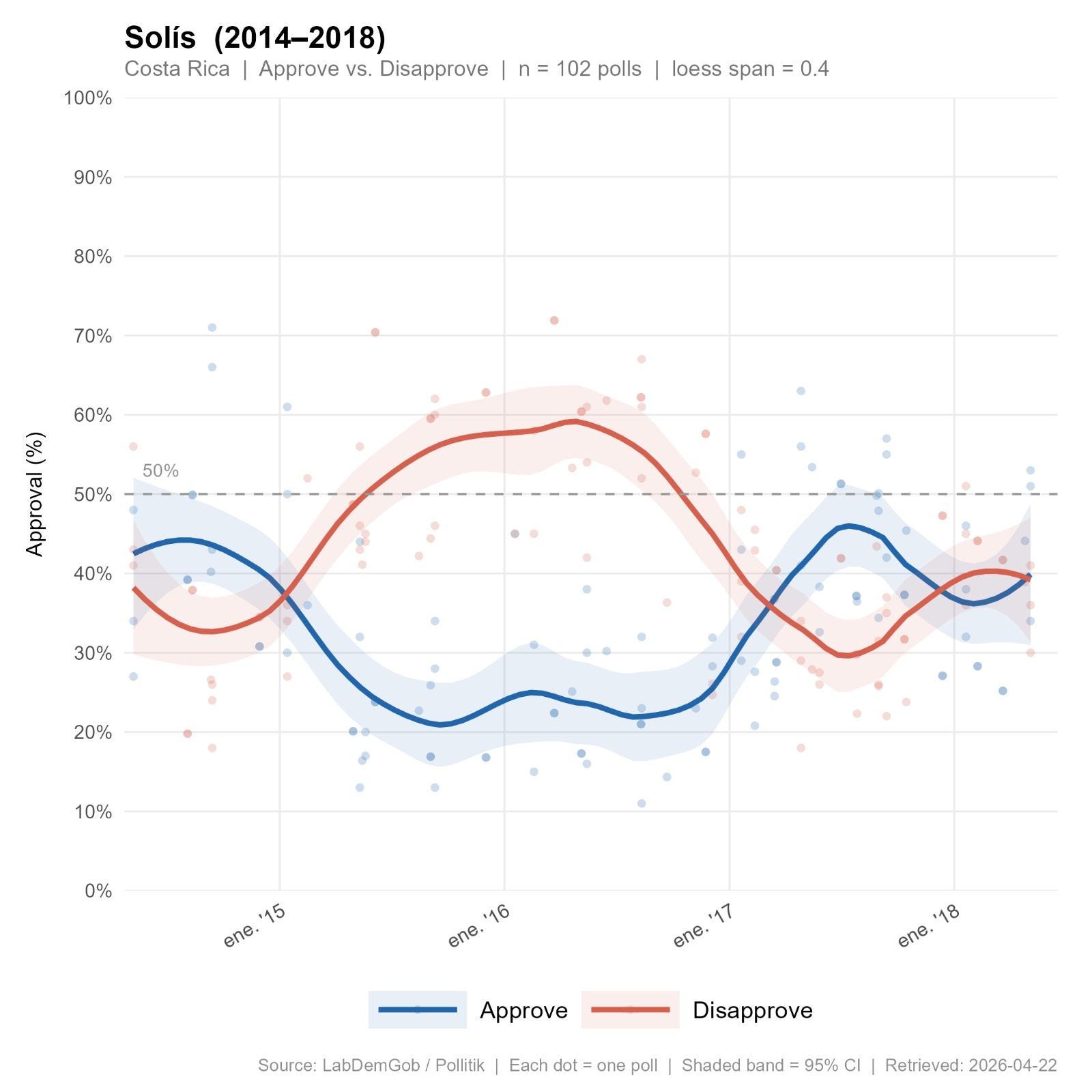
Figure 5. Presidential approval.
Carlos Alvarado experienced one of the weakest approval trajectories among recent presidents. His term was marked by high volatility, contentious reforms, and prolonged periods of low support. By the end of his presidency, approval had fallen substantially. In contrast, Chaves inherited public frustration with the political establishment and transformed that sentiment into a more stable support coalition. Whereas Alvarado struggled to sustain legitimacy, Chaves has maintained a stronger and more resilient approval floor.
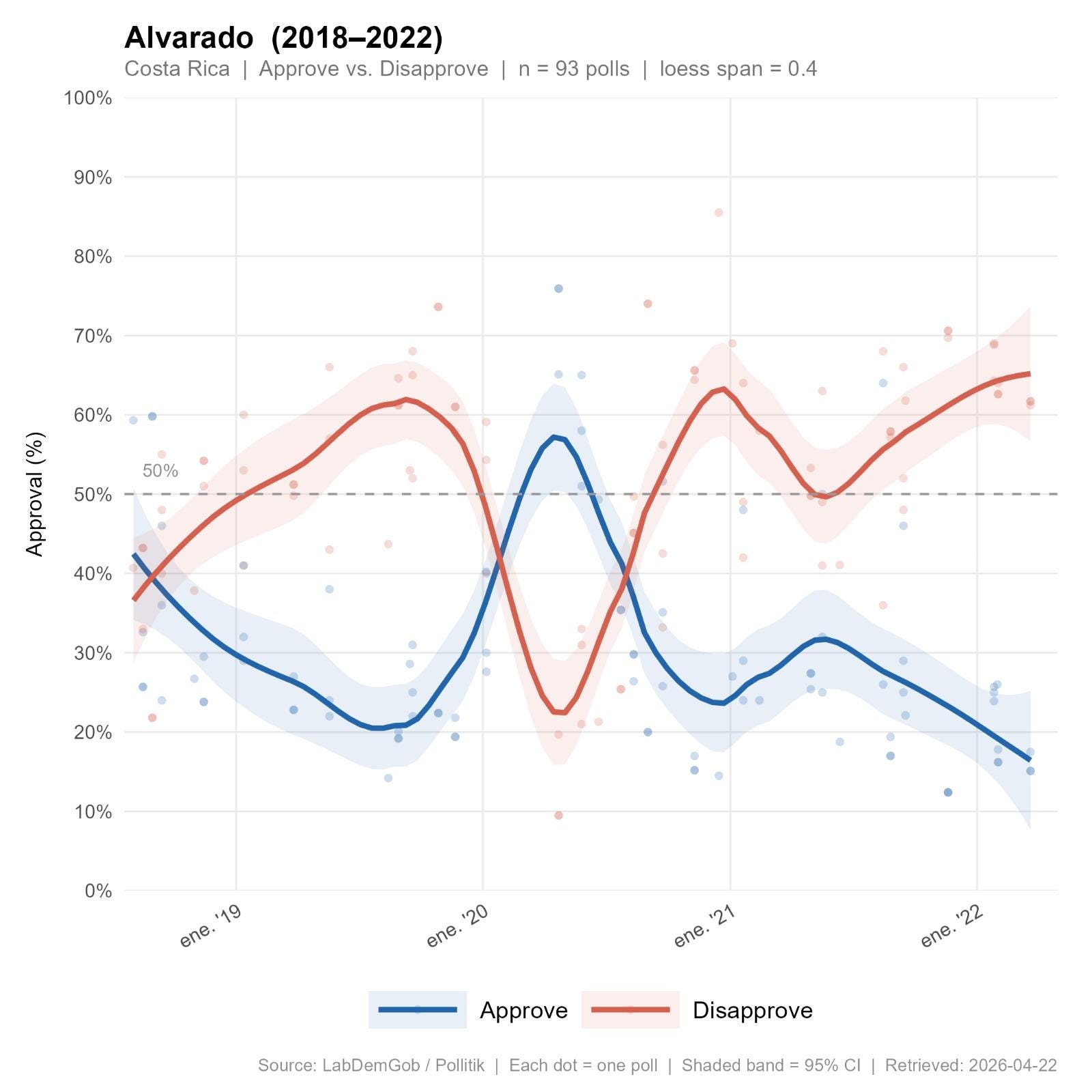
Taken together, these comparisons confirm that sustained approval is not the norm in Costa Rican politics. Against that broader historical pattern, Chaves’s trajectory appears exceptional rather than routine.
In comparative perspective, an approval level above 60% late in the term is unusual in Costa Rica. It suggests that although the president faces clear institutional limits, he has preserved political legitimacy among a significant share of voters. The central paradox of the Chaves presidency is therefore strong public support coexisting with constrained governability.

OUTLOOK
1. Determinants of Chaves’s future political influence
Chaves’s influence after leaving office will depend on whether his personal appeal can survive the transition to President‑elect Laura Fernández, whose victory shows his electorate can be partially transferred but not yet institutionalized. His long‑term relevance will hinge on whether his support becomes a durable partisan network or dissolves once he is no longer on the ballot. Security outcomes, economic perceptions, and administrative performance will shape retrospective evaluations, while his confrontational governing style ensures a polarized legacy. Ultimately, how Fernández governs, whether she improves security, reduces conflict, or struggles with the same constraints, will determine whether Chaves is remembered as the start of a realignment or a temporary personalist moment.
2. Economic and social context after the presidency
Costa Rica will enter the post‑Chaves period with strong institutions but persistent pressures tied to inequality, territorial divides, and unmet social expectations. The central challenge for the Fernández administration will be converting macroeconomic stability into visible improvements in wages, living costs, and public services, since voters judge governments through everyday experience. Labor market disparities, regional inequality, and rising insecurity, especially organized crime, will continue fueling frustration and outsider appeals. Although polarization may persist, Costa Rica’s institutional resilience offers space for negotiated solutions if new leadership addresses these structural grievances.
3. Institutional effects on the political system
The Chaves presidency is likely to deepen personalization of politics, weaken traditional parties, and normalize permanent campaign‑style communication. Persistent executive‑legislative conflict may heighten public frustration with institutional bargaining, while tensions with autonomous institutions could further politicize trust in checks and balances. His confrontational style has mobilized new voters but also intensified divisions, leaving a more engaged yet more polarized electorate. These dynamics accelerate Costa Rica’s shift toward a fragmented, leader‑centered model whose impact on governability will depend on how Fernández and future actors adapt.

MORE INFORMATION
Data sources
Al Jazeera. (2026, February 1). Polls open in Costa Rica as centre-right populists aim to extend mandate.https://www.aljazeera.com/news/2026/2/1/polls-open-in-costa-rica-as-centre-right-populists-aim-to-extend-mandate
Banco Central de Costa Rica. (2026). Informe de política monetaria: Enero 2026. https://www.bccr.fi.cr/comunicacion-y-prensa/Docs_Comunicados_Prensa/cp-bccr-003-2026-informe-politica-monetaria-enero-2026.pdf
Bertelsmann Stiftung. (2024). BTI 2024 country report: Costa Rica.https://bti-project.org/en/reports/country-report/CRI
Cascante Cordero, V., & Lai Liu, E. S. (2025). Propuesta de reforma electoral: Acortamiento del intervalo entre rondas. Revista de Derecho Electoral, Tribunal Supremo de Elecciones.https://www.tse.go.cr/revista/art/39/cascante_lai.html
Transparencia Electoral. (2022). Elecciones presidenciales Costa Rica 2022: Situación post electoral.https://transparenciaelectoral.org/observatoriodemujeresypolitica/elecciones-presidenciales-costa-rica-2022-situacion-post-electoral/
Tribunal Supremo de Elecciones. (2026). Encuestas electorales y disposiciones para las elecciones nacionales 2026.https://www.tse.go.cr/2026/encuestas.html
U.S. Department of State. (2021). Country reports on human rights practices: Costa Rica. https://www.state.gov/reports/2021-country-reports-on-human-rights-practices/costa-rica/
Universidad de Costa Rica. (2026, marzo 4). Encuesta CIEP-UCR: El “candidato” Chaves fue el factor de más peso en el resultado electoral. https://radios.ucr.ac.cr/-/encuesta-ciep-chaves-factor-de-mas-peso
Methods
This report analyzes presidential approval in Costa Rica using a time-series of public opinion surveys from May 2022 to early 2026. The dataset was constructed from available polls with clear fieldwork dates to ensure consistency.
The data was processed in RStudio to generate trend visualizations. To identify underlying patterns, a LOESS smoothing technique was applied, reducing short-term fluctuations and highlighting medium-term dynamics in approval.
This approach allows for the identification of key phases, such as the honeymoon period, decline, and stabilization, providing a clearer interpretation of structural changes in public support over time.
Team
Octavio Gomez Hernandez, Elias Choudhury, Will Humphries, Maximo Vargas, Ingrid Portilla, Camila Sepulveda, Derrol Alexis.
Coverage
This report focuses on Costa Rica’s nation-wide presidential voting behavior in the 20-year events leading to and during the 2026 presidential election at February 1st.