

ELECTORAL ANALYSIS: CHILE
Presidential Elections 16 November 2025


OVERVIEW
The December 2025 Chilean presidential election resulted in a decisive victory for José Antonio Kast of the Republican Party, who defeated Jeannette Jara with 58.2% of the vote to 41.8%. This outcome marked a significant shift toward the political right following the left-wing administration of Gabriel Boric.
This report applies a backcasting approach, using only structural indicators and pre-election polling data to evaluate how the outcome could have been anticipated. While individual polls frequently showed Jara leading in the first round, broader electoral patterns and bloc-level support suggested a structural advantage for right-leaning candidates in a runoff scenario.
The findings indicate that a model incorporating both long-term electoral cycles and short-term vote consolidation would have identified Kast as a likely eventual winner, despite initial polling ambiguity.

BACKGROUND
Pre-Election Forecast Signals (Backcasting Framework): Pre-election polling data consistently placed Jara ahead in first-round vote intention. However, polling also revealed that support for right-leaning candidates was fragmented across multiple contenders. When aggregated, total support for right-leaning candidates frequently exceeded 45-50%, suggesting a latent electoral majority that was not fully captured by individual candidate polling. This distinction between candidate-level polling and bloc-level support is critical. A forecasting model accounting for ideological consolidation in a runoff would likely have identified Kast as the stronger second-round candidate.
The 2025 election reflected a polarized contest between competing visions of Chile’s political and economic future. Key campaign issues included public security, economic performance, and immigration policy.
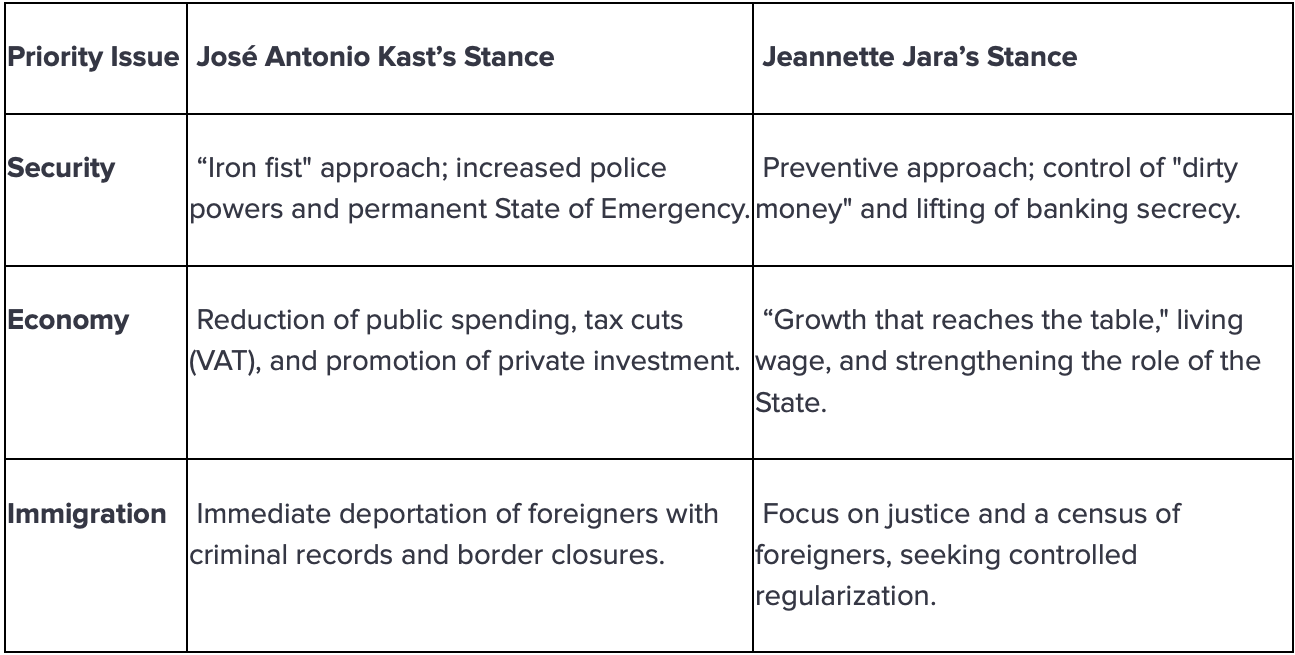
Kast’s campaign aligned closely with rising voter concerns about crime and economic stagnation, while Jara’s platform emphasized continuity with the Boric administration’s reform agenda.
Role of Polls and Alternative Indicators: Traditional polling sources (e.g., CADEM, CEP, Criteria) struggled to fully capture the magnitude of right-wing support during the campaign period.
Magnitude Error: Polls underestimated support for secondary right-wing candidates, making Jara’s lead appear more secure than it was.
Bloc Underestimation: Aggregated right-wing vote intention exceeded that of the left in multiple surveys.
Alternative Indicators: Measures such as political sentiment and approval trends signaled growing dissatisfaction with the incumbent government.
These dynamics suggest that reliance on individual polling alone led to systematic underestimation of Kast’s eventual margin of victory.
Factors of Victory (Recent Past): Kast’s victory can be explained through a combination of structural and short-term factors:
Long-Term (Structural): Chile’s electoral pattern shows alternating support between left- and right-leaning coalitions (“electoral pendulum”), creating conditions favorable to a rightward shift after Boric’s presidency.
Short-Term (Conjunctural): Rising concerns about crime, economic dissatisfaction, and effective campaign messaging allowed Kast to consolidate support across fragmented right-wing voters.

LONG-TERM TRAJECTORY
Chile’s presidential elections over the past decade demonstrate a pattern of alternating ideological control between left and right.
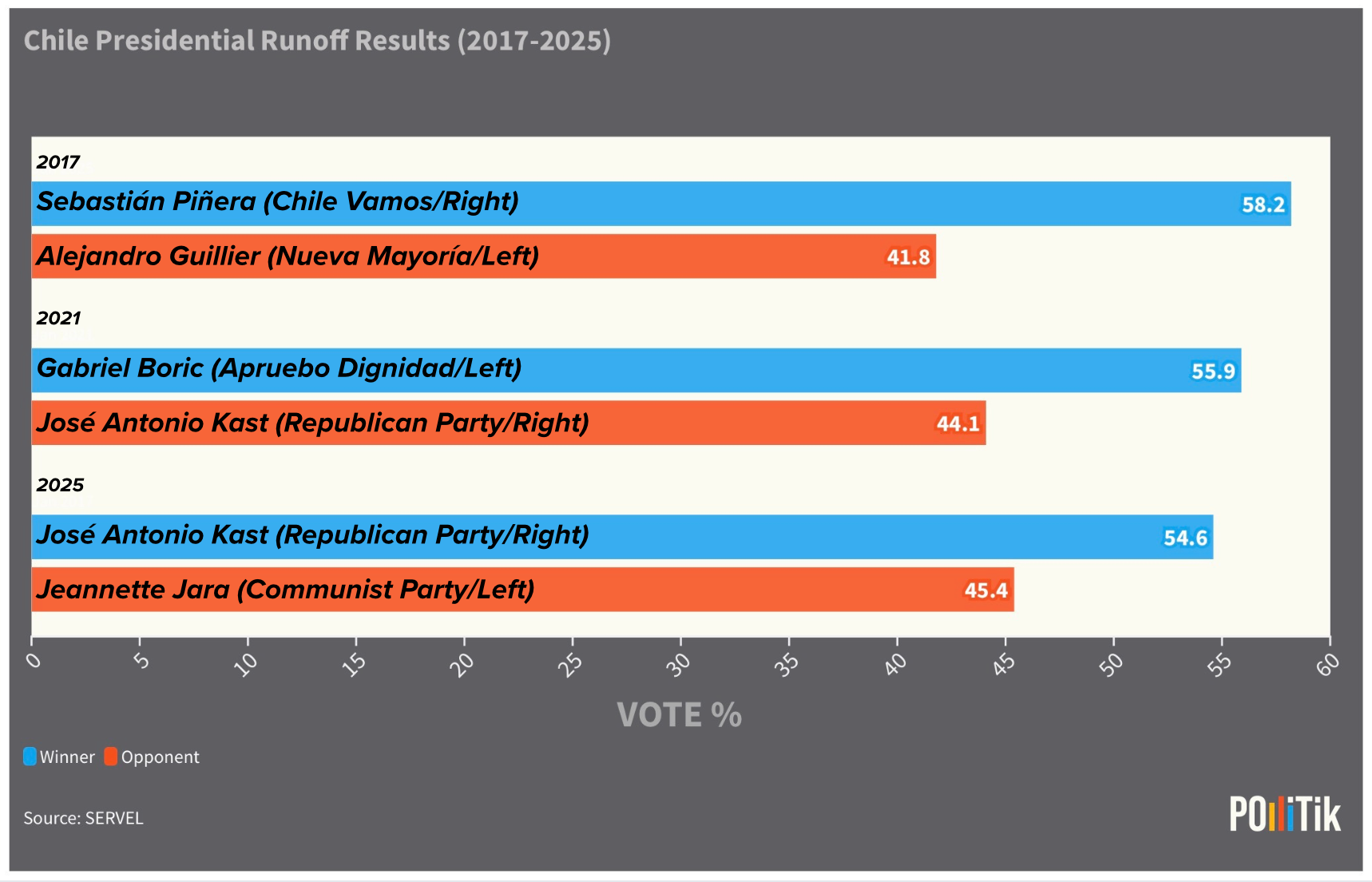
Source: Chile Electoral Service (SERVEL)
This pattern reflects a broader electoral pendulum, where voters shift between ideological blocs in response to incumbent performance.
By 2025, dissatisfaction with economic conditions and public security contributed to a political environment favorable to a right-leaning candidate. A fundamentals-based model incorporating these structural dynamics would likely have projected a competitive race with a rightward advantage.
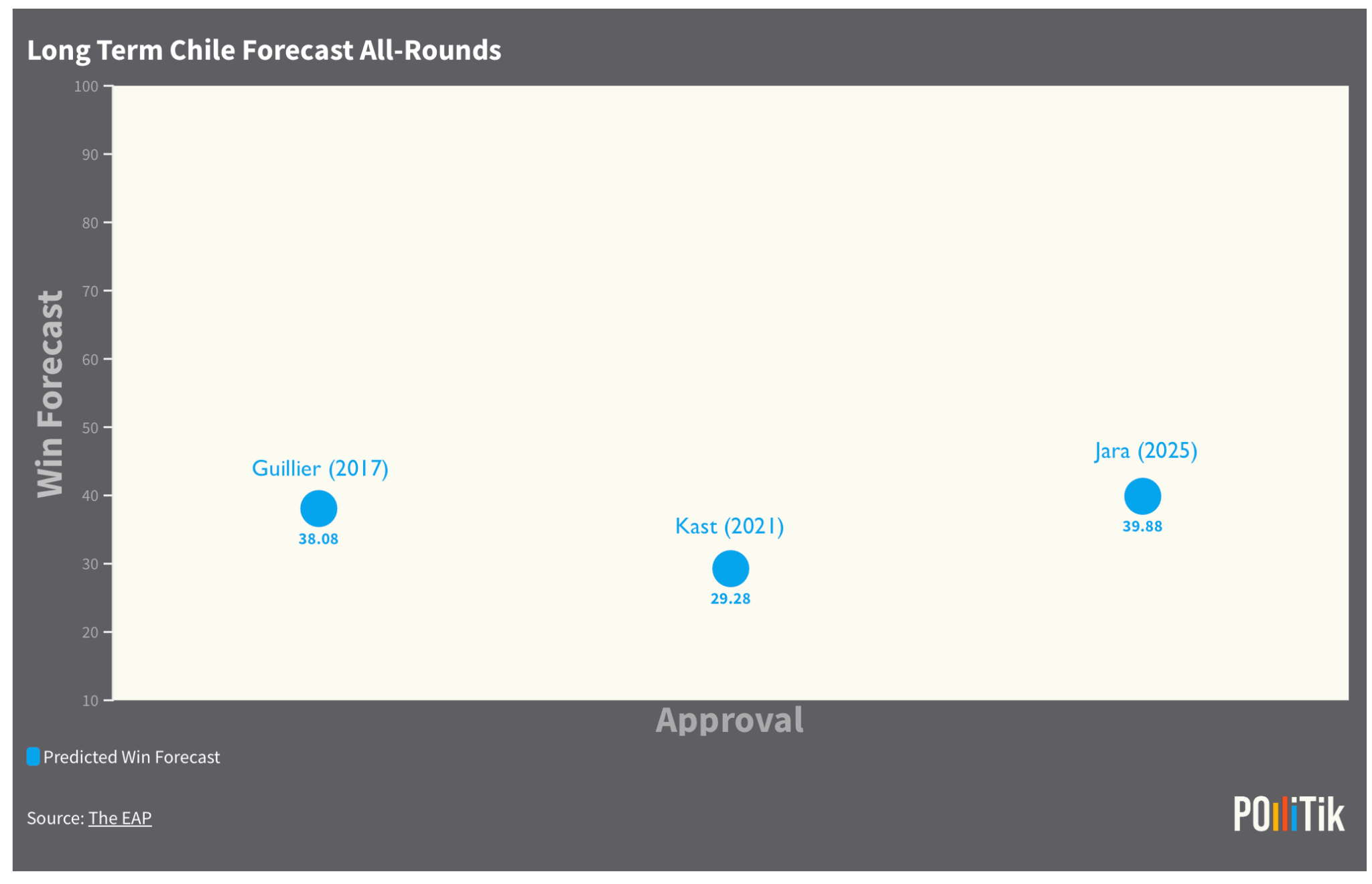
Approval and Expected Electoral Performance in Chile (2017–2025)
Source: The EAP
This figure illustrates the relationship between candidate approval and predicted electoral performance across recent Chilean elections. While higher approval generally corresponds with stronger projected outcomes, the variation between cases highlights that approval alone is not determinative. For instance, Kast (2021) exhibits lower approval yet remains competitive, suggesting that broader structural dynamics, such as ideological alignment and bloc strength, play a decisive role. This reinforces the argument that Chile’s electoral outcomes are better explained by long-term patterns, including the electoral pendulum, rather than approval in isolation.

SHORT-TERM TREND
The chart shown below spans the period from January 2023 to November 16, 2025, incorporating data from the majority of national polls. The data illustrates a rising trend for right-wing forces, initially led by Evelyn Matthei. However, Matthei experienced a significant decline in polling preferences beginning in January 2025, a shift that coincided with a substantial surge for José Antonio Kast. Kast maintained this momentum and was ultimately elected following the electoral cleavage.
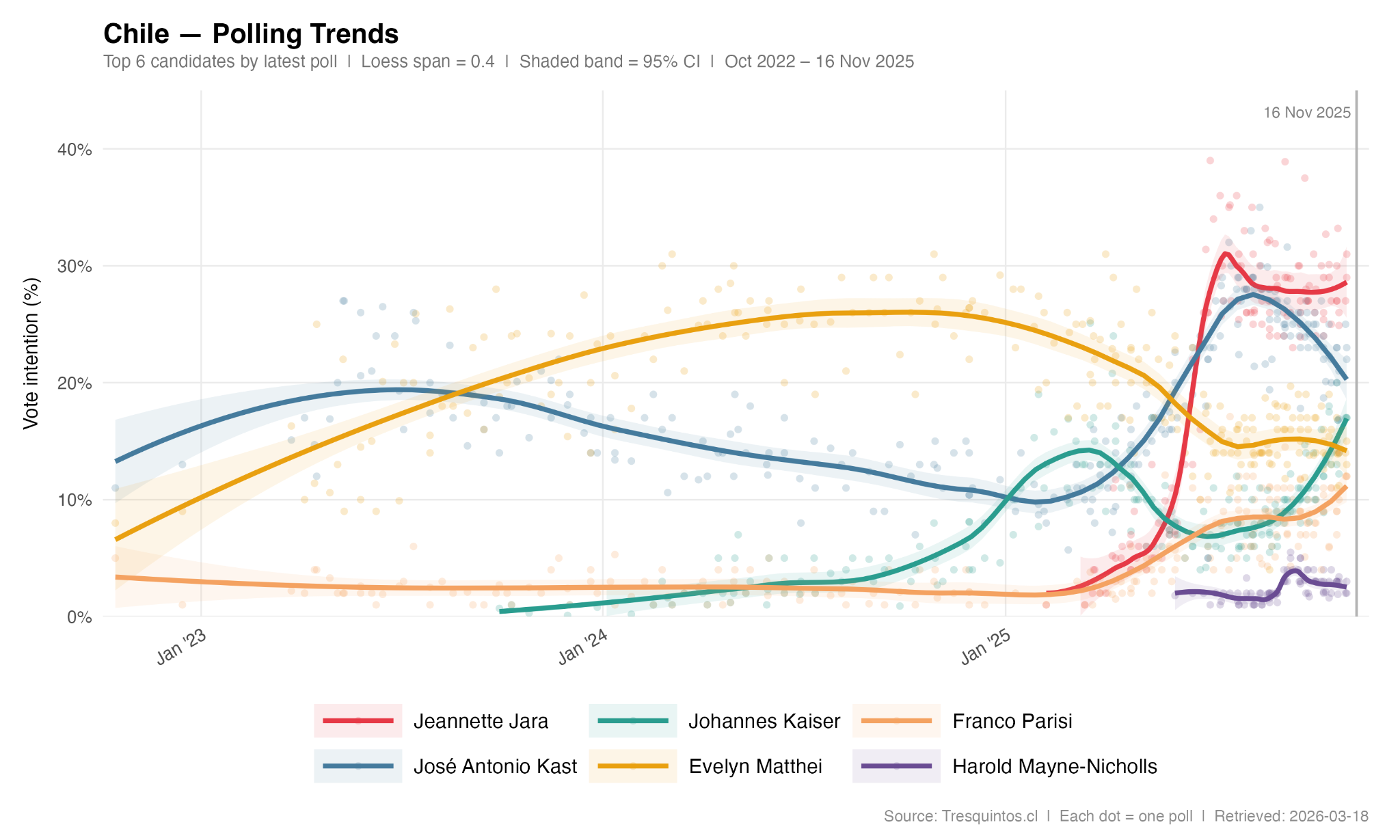
Polling and Fragmentation Dynamics
Pre-election polling consistently placed Jeannette Jara ahead in first-round vote intention. However, these projections masked a critical structural dynamic: the fragmentation of right-wing support across multiple candidates. While no single right-leaning candidate initially matched Jara’s polling numbers, the combined support of right-wing contenders frequently exceeded that of the left.
This discrepancy reveals a key limitation of candidate-level polling, which captures individual performance but fails to account for ideological bloc strength. As the campaign progressed, fragmented right-wing support consolidated, most notably around José Antonio Kast, transforming an apparent polling deficit into a competitive and ultimately dominant runoff position.
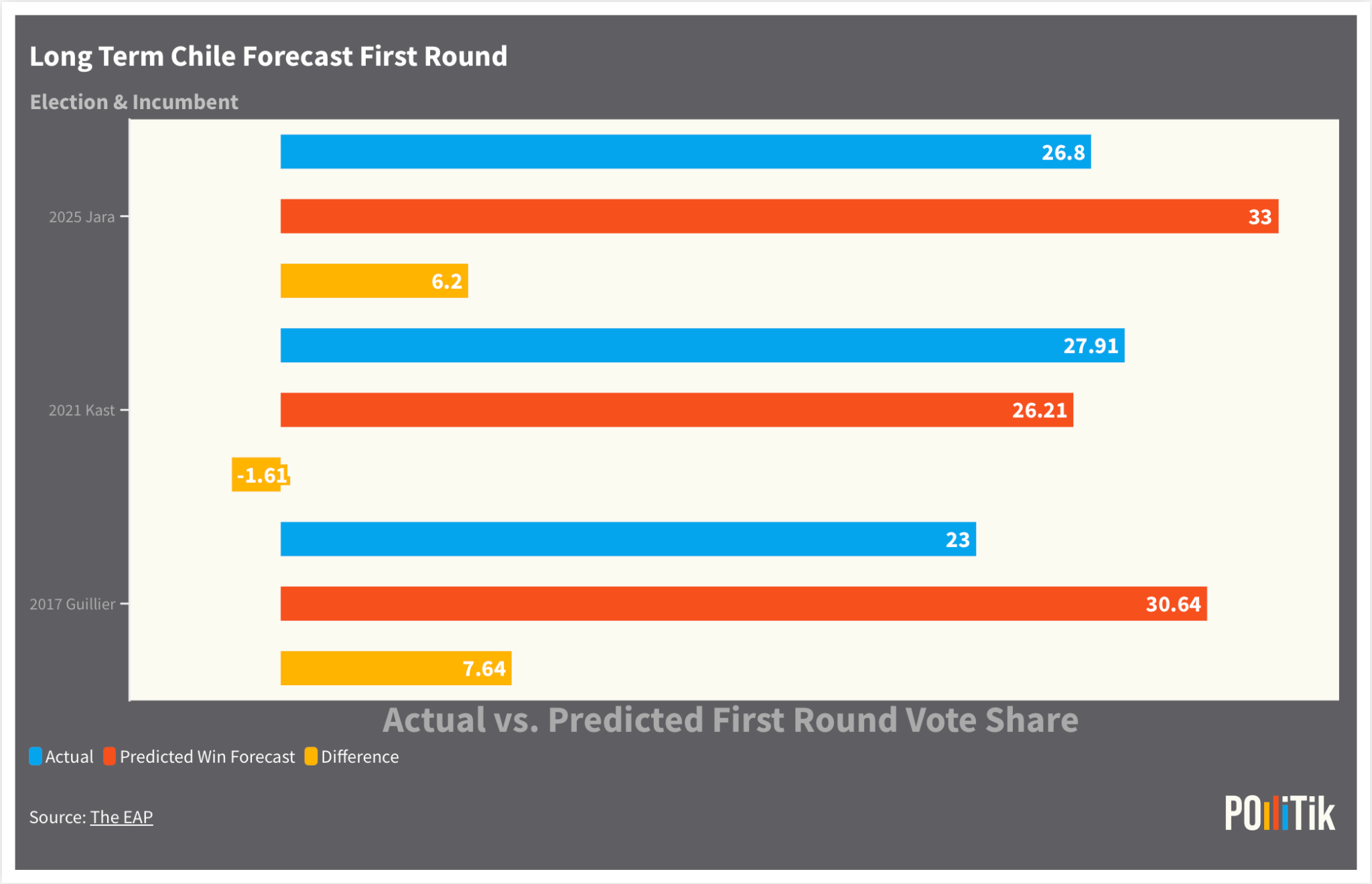
Actual vs. Predicted First Round Vote Share (2017–2025)
Source: The EAP
The figure above reinforces this dynamic by comparing forecasted and actual first-round vote shares. In 2017 and 2025, left-leaning candidates were overestimated, while right-leaning support was either underestimated or distributed across multiple candidates. These gaps highlight how polling, when interpreted at the candidate level alone, can misrepresent the broader electoral balance.
This forecast identifies three distinct and influential right-wing factions. The first is the traditional right, represented by Evelyn Matthei (UDI) of the Chile Vamos coalition, which has held office twice in the country’s history. The other two represent more ‘renewed’ and hard-line iterations of the right: José Antonio Kast (PR) and Johannes Kaiser (PNL). While Kaiser consistently ranked third in the polls and Kast second, the latter held a strategic advantage for the runoff election when aggregating the projected support from both right-wing and centrist candidates.
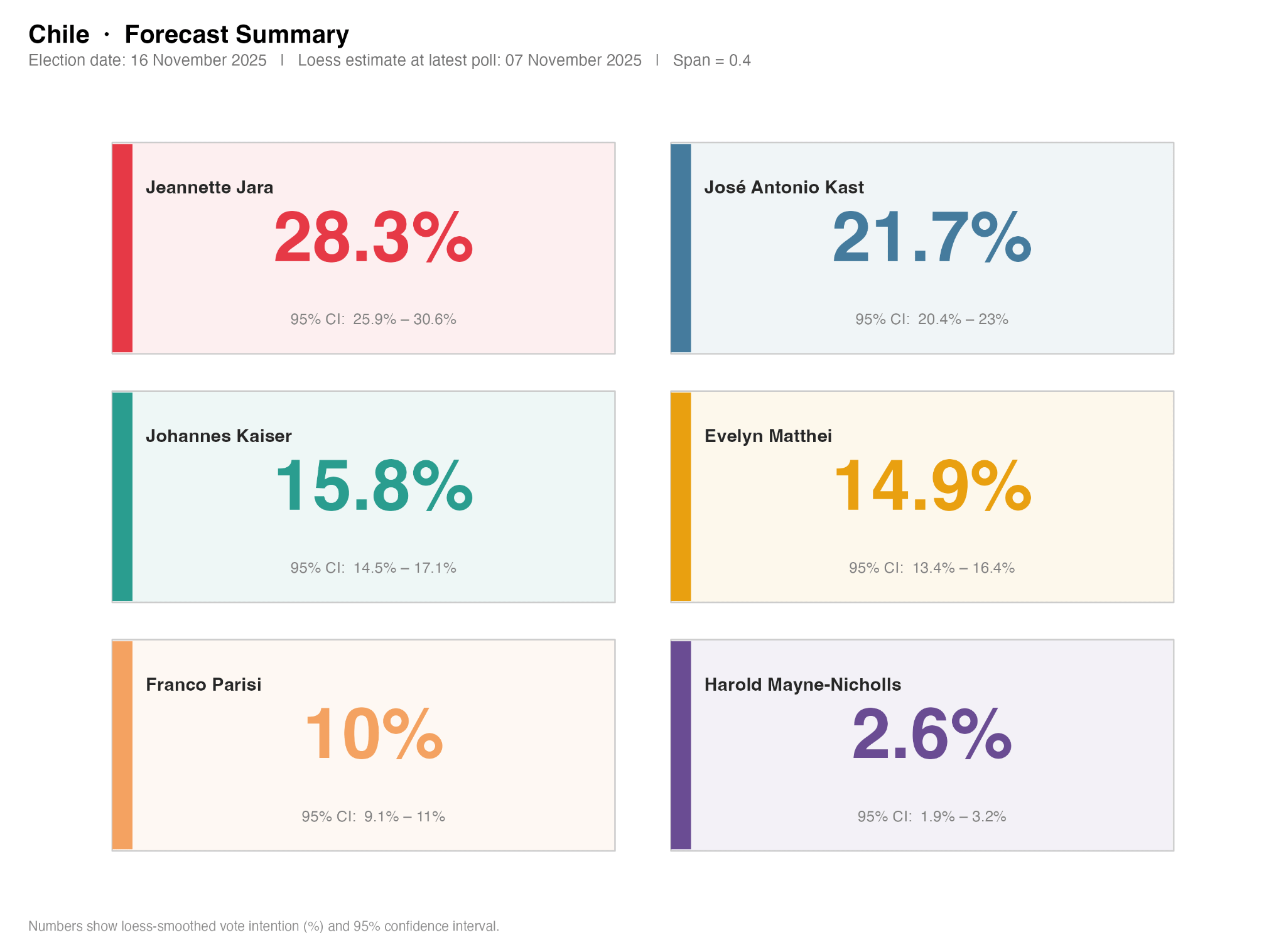
Ultimately, the forecasts project Jeanette Jara as the winner in the first round with 28.3% of the vote, followed by José Antonio Kast at 21.7%, who maintains a significant probability of prevailing in the runoff election. These candidates are followed by right-wing contenders Johannes Kaiser (15.8%) and Evelyn Matthei (14.9%). Finally, Franco Parisi is positioned with 10% of the vote, while Harold Mayne-Nicholls ranks last among the selected candidates with 2.6% of the vote.

FINDINGS
Combining long-term structural trends with short-term polling data provides a clearer explanation of the 2025 outcome.
Long-term patterns suggested a likely ideological shift following Boric’s presidency
Polling data indicated strong but fragmented right-wing support
Runoff dynamics enabled consolidation behind a single candidate
The final result confirmed this model: Kast won with 58.2% compared to 41.8% for Jara.
A forecasting model incorporating both structural electoral cycles and bloc-level vote aggregation would have likely predicted:
A Jara lead in the first round
A competitive runoff
A probable advantage for Kast in the final round
This case highlights the limitations of relying solely on candidate-level polling and underscores the importance of structural and bloc-based analysis in electoral forecasting.

MORE INFORMATION
Data sources
Chile Electoral Service (SERVEL) - official election results
Public opinion surveys (CADEM, CEP, Criteria, Panel Ciudadano)
Methods
This analysis uses a backcasting approach, combining historical election results with pre-election polling data. Long-term trends were assessed using past presidential elections (2017-2025), while short-term dynamics were evaluated using polling data from the final months of the campaign.
Team
Joseph Pagan-Portes, Aisha Siddiqi, Margaux Melby, Martin Ayala, Catalina Salamanca
Coverage
This report focuses on national-level presidential voting behavior in Chile’s 2025 election, with particular emphasis on runoff dynamics and ideological vote consolidation.